

From an empty page to a structured research blueprint: your thesis proposal is the bridge between curiosity and architectural knowledge.
The architectural thesis proposal is the most critical document in a graduate student’s academic journey, yet it remains one of the most intimidating [1]. It is the moment where abstract curiosity must crystallize into a rigorous research framework, where scattered ideas must coalesce into a coherent argument, and where personal passion must meet academic rigor [1]. For architecture students, this challenge is compounded by the discipline’s unique position at the intersection of art, science, and social inquiry, demanding a research methodology that can accommodate design experimentation while maintaining scholarly credibility [2]. A recent study examining the gap between architectural education and practice identified that 73% of architecture graduates felt inadequately prepared for conducting systematic research, pointing to a significant pedagogical void in research methodology training [3]. This article presents a strategic, step-by-step framework for constructing compelling architectural research proposals, grounded in both established academic principles and the specific demands of design-led inquiry [1].
The Hidden Architecture of Research Logic: Understanding What a Proposal Really Does
Before diving into the mechanics of proposal writing, it is essential to understand the fundamental purpose of this document [4]. A research proposal is not merely an administrative requirement or a formality to be completed before beginning design work; it is the intellectual blueprint that will guide the entire trajectory of your investigation [4]. The proposal serves three critical functions simultaneously: it establishes the urgency and originality of your research question, it demonstrates that you have a systematic and logical plan to address this question, and it projects credible outcomes that will contribute to architectural knowledge [5].
The concept of research urgency deserves particular attention in architectural studies [2]. Unlike disciplines where problems are clearly defined by empirical gaps, architectural research often emerges from the intersection of theoretical inquiry and practical challenges [2]. Your proposal must articulate why this specific investigation matters now – whether it follows emerging trends in computational design, addresses pressing sustainability challenges in tropical climates, or fills a gap in our understanding of vernacular building traditions [6]. This urgency must be justified through both conceptual frameworks and empirical evidence, creating what research methodologists call a “problematic situation” – a demonstrable gap between current conditions and ideal states that demands explanation [7].

The hidden architecture of research logic: how urgency, problem, framework, methods, and outcomes interlock inside a strong proposal.
Constructing the Research Gap: The Foundation of Originality
The identification of a research gap is perhaps the most intellectually demanding aspect of proposal development, requiring systematic analysis of existing literature and critical evaluation of what remains unexplored [8]. In architectural research, gaps manifest across multiple dimensions: theoretical gaps where existing concepts fail to explain observed phenomena, methodological gaps where new techniques are needed to investigate complex problems, and empirical gaps where specific contexts or typologies remain understudied [9].
A robust gap identification process begins with comprehensive literature mapping, utilizing systematic search strategies across multiple databases including Web of Science, Scopus, and discipline-specific repositories [8]. This is not a passive review but an active process of conceptual mapping, where you chart the territory of existing knowledge to identify the frontiers [8]. Advanced techniques such as co-citation analysis can reveal clusters of related research and potential blind spots, while temporal analysis tracks how research themes have evolved over time, identifying dormant areas ripe for renewed investigation [8].
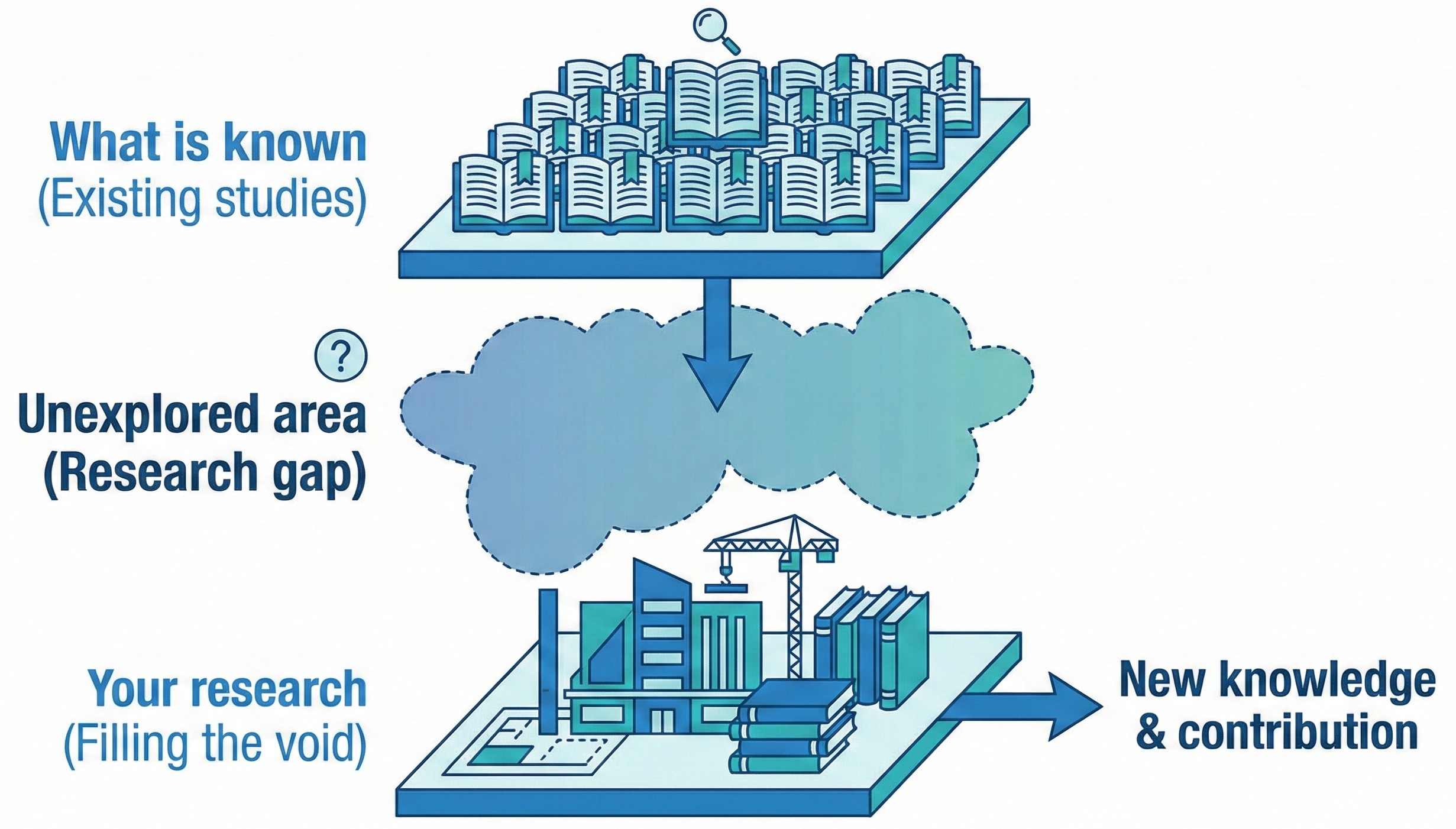
Visualizing the research gap: positioning your study between what is already known and what architectural practice still needs to understand.
For architectural research specifically, gap identification must consider the unique nature of design-led inquiry [10]. Traditional systematic review methods developed for medical or social sciences may need adaptation to accommodate the iterative, reflexive nature of design research [10]. A study examining research methodologies in architecture found that effective gap identification requires “hybrid methods” that combine traditional literature analysis with critical examination of built precedents, emerging technologies, and evolving cultural contexts [10]. The goal is not simply to find what hasn’t been studied, but to identify what needs to be studied to advance both theoretical understanding and practical application [6].
Articulating the Problem Statement: Precision as Power
The problem statement is the intellectual core of your proposal – the sentence or brief paragraph that captures the essence of your research challenge with absolute clarity [11]. In architectural research, crafting an effective problem statement requires balancing specificity with relevance, ensuring your question is neither so narrow that it lacks broader significance nor so broad that it becomes unmanageable [11].
An effective problem statement contains several essential elements: it identifies the specific phenomenon or issue to be investigated, it contextualizes this problem within existing knowledge (what we already know), it articulates precisely what remains unknown (what we need to know), and it demonstrates why this knowledge gap matters (why we need to know it) [11]. For design-based architectural research, the problem statement must also indicate how design inquiry will serve as a method of knowledge creation, not merely as the end product [10].
Consider the difference between a weak and strong problem statement in architectural research. A weak statement might read: “This research will explore sustainable design in tropical architecture.” This lacks specificity, fails to identify a clear gap, and provides no indication of methodology or significance [11]. A strong statement would be: “Despite growing evidence that computational optimization of building envelopes can reduce cooling energy by 20-30% in tropical climates, the integration of parametric design tools into the design curriculum of Southeast Asian architecture programs remains limited, with 89% of practitioners reporting inadequate training in these methods. This research investigates how visual programming platforms can be strategically integrated into design studio pedagogy to enhance students’ capacity for climate-responsive design thinking.” This statement identifies a specific problem (gap in computational design education), contextualizes it with evidence, and indicates both methodology (pedagogical intervention) and significance (enhanced climate-responsive design capacity) [11].
The problem statement must be inherently “problematic” – it must identify a genuine tension, contradiction, or gap that demands resolution [7]. In architectural research, this often emerges from the disconnect between theoretical ideals and practical realities, between global trends and local contexts, or between established methods and emerging challenges [2].

Core structure of an architectural research proposal: from background and problem statement to framework, methods, and timeline.
Building the Conceptual Framework: The Intellectual Scaffold
If the problem statement is the core of your proposal, the conceptual framework is the intellectual scaffold that supports your entire investigation [12]. A conceptual framework in architectural research is “a network of interlinked concepts that together provide a comprehensive understanding of a phenomenon,” serving as both a lens through which you view your research problem and a structure that organizes your inquiry [12].
The development of a conceptual framework follows a systematic process [13]. First, you must identify your overarching research question and study parameters – the boundaries that define what is and isn’t included in your investigation [12]. Second, you extract key concepts and variables from your literature review, identifying the fundamental ideas that will structure your analysis [12]. Third, you map the relationships between these concepts, creating a visual or verbal representation of how they interact to produce the phenomenon you’re studying [12].
For architectural research, conceptual frameworks often draw from multiple disciplinary sources – architectural theory, environmental science, social theory, computational logic, or material science – creating what scholars call an “interdisciplinary positioning” [13]. This multidisciplinary integration is not merely additive but synthetic, creating new theoretical constructs that can address the complexity of architectural problems [13].
A particularly powerful framework structure in design research is the “input-throughput-output” model, which maps how raw data and observations (inputs) are processed through analytical and synthetic methods (throughput) to generate design solutions or theoretical insights (outputs) [12]. This model makes the research process transparent and replicable, addressing a common criticism of design research as being overly subjective or opaque [10].
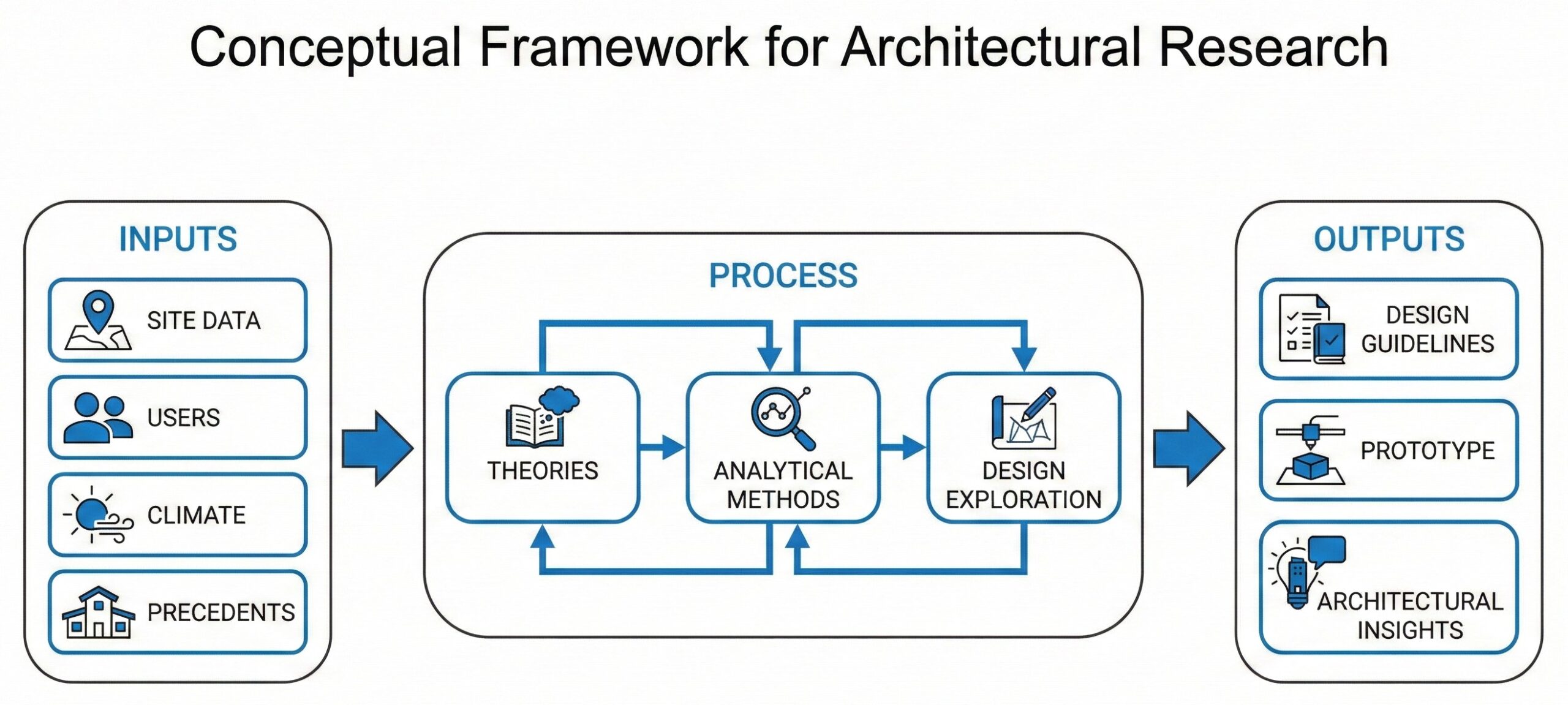
A conceptual framework in architecture links inputs, processes, and outputs into a coherent system of ideas that guides both analysis and design decisions.
The conceptual framework should be presented both verbally and visually [12]. The verbal articulation explains the theoretical underpinnings and relationships in detail, while the visual representation – often a diagram or flowchart – provides an at-a-glance understanding of your research logic [12]. In architectural research, where visual thinking is fundamental to the discipline, the quality of your framework diagram often serves as a proxy for the clarity of your thinking [2].
Navigating Methodological Complexity: Design as Research, Research as Design
Methodology remains the most misunderstood section of architectural research proposals, often confused with methods, approaches, or data collection techniques [4]. To clarify: methodology refers to your overall research strategy and philosophical stance – the “why” behind your choices – while methods are the specific techniques and tools you will use – the “how” of your investigation [4].

Research through design as an iterative cycle: framing problems, experimenting through design, evaluating, and feeding insights back into theory.
In architectural research, methodological complexity arises from the discipline’s dual nature as both a creative practice and an academic field [10]. Traditional research paradigms – quantitative, qualitative, and mixed-methods – must be adapted to accommodate design-led inquiry, where the act of designing itself serves as a mode of knowledge creation [14]. This has led to the emergence of specific methodological frameworks for architectural research, including “research through design,” “research for design,” and “research about design” [14].
Research Through Design: When Making is Knowing
Research through design positions the design process itself as the primary method of investigation, where iterative design experimentation generates new knowledge about materials, forms, or spatial relationships [14]. This approach, widely adopted in design-led PhD programs at institutions like MIT and the Royal Danish Academy, treats each design iteration as a “probe” that tests hypotheses and reveals unexpected insights [13].
Implementing research through design in your proposal requires articulating how design decisions will be systematically documented, analyzed, and reflected upon [14]. You must establish criteria for evaluating design outcomes that go beyond subjective aesthetic judgment to include measurable performance metrics, user experience data, or theoretical consistency [14]. A study of design-led research methods emphasizes the importance of “systematic quality criteria” including regularity (consistent application of methods), relevance (clear connection to research questions), and universality (applicability beyond the specific case) [15].
Qualitative Methods in Architectural Research: Beyond Observation
Qualitative research methods – including interviews, ethnography, case studies, and document analysis – are particularly valuable in architectural research for understanding how spaces are experienced, how design processes unfold, and how cultural contexts shape built form [16]. However, architectural applications of qualitative methods require discipline-specific adaptations [16].
The “six tactics” framework developed for architectural fieldwork in vernacular contexts provides a practical model: documentation through photography and sketching, physical surveys using anthropometric measurement, in-depth interviews with open-ended questions, interactive discussions with community stakeholders, participatory observation where the researcher engages directly with spatial use, and architectural interpretation that synthesizes findings into design-relevant insights [17]. These tactics are “initiated inductively, formulated contextually with ethics and aesthetics, and communicated with simple language” [17].

Mapping research methods in architecture: qualitative, quantitative, and mixed approaches overlap to address complex spatial questions.
Bridging the Gap: Mixed Methods and Hybrid Approaches
Given the complexity of architectural problems, mixed-methods approaches that combine quantitative performance analysis with qualitative spatial experience research often provide the most comprehensive understanding [18]. Computational simulations can quantify energy performance, daylighting, or structural efficiency, while interviews and observations reveal how users actually interact with and perceive these spaces [16].
A recent methodological review of architectural research proposes “hybrid methods” that simultaneously apply different modes of inquiry based on the specific demands of each research phase [10]. For example, early exploratory phases might emphasize qualitative case studies and interviews to understand the problem deeply, middle phases might employ quantitative parametric studies to test design variables, and later phases might return to qualitative methods to evaluate the experiential quality of design outcomes [10].
Your proposal must clearly articulate not only which methods you will use but why these specific methods are appropriate for your research questions and how they will be integrated to produce coherent findings [4].
Literature Review as Intellectual Cartography: Mapping the Territory
The literature review section of your proposal is not a comprehensive summary of everything ever written on your topic; rather, it is a strategic mapping of the intellectual territory that contextualizes your specific contribution [19]. This distinction is critical: a literature review should be selective, critical, and above all, argumentative – it should build a case for why your research is necessary [19].
A systematic approach to literature review follows structured protocols that make your search strategy transparent and replicable [20]. Begin by formulating clear search queries using the “building blocks” method, where each key concept in your research question becomes a separate search term [20]. For example, if investigating computational design methods for bamboo structures, your building blocks might be: (1) “computational design” OR “parametric design” OR “algorithmic design,” (2) “bamboo” OR “natural materials,” and (3) “structural optimization” OR “form-finding” [20].
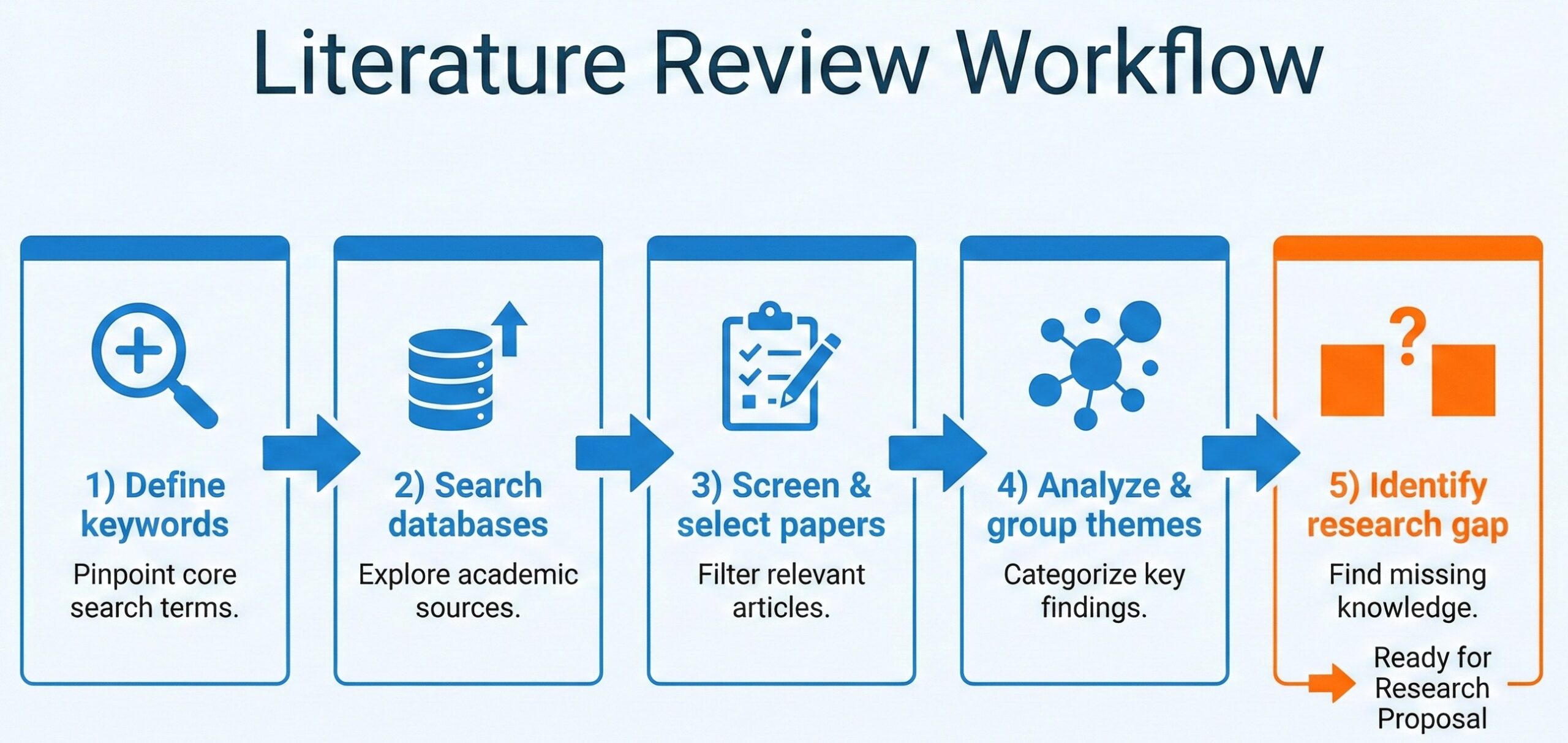
From keywords to gaps: a step‑by‑step workflow for turning a literature review into a clear argument for your architectural research.
Document your search process meticulously, recording which databases you searched, what search strings you used, how many results each query generated, and what date you conducted the search [21]. This documentation serves two purposes: it demonstrates the rigor of your review process, and it allows you to update your search later when revising or expanding your research [21].
The analysis phase of your literature review should organize findings thematically or chronologically, identifying patterns, contradictions, and gaps [19]. For architectural research, consider organizing your review around key debates in the field (e.g., the tension between vernacular authenticity and contemporary innovation), methodological approaches (e.g., different techniques for assessing thermal comfort), or case study typologies (e.g., comparative analysis of tropical climate design strategies) [6].
Critically, your literature review must culminate in a clear articulation of the research gap that your study will address [8]. This is where you explicitly state: “Previous research has examined X and Y, but has not adequately addressed Z, which is significant because…” [8]. This gap statement serves as the bridge between existing knowledge and your proposed contribution [8].
Defining Scope and Limitations: The Boundaries of Rigor
A common mistake in research proposals is attempting to address too broad a scope, leading to superficial treatment of complex issues [22]. Paradoxically, narrowing your scope actually strengthens your proposal by demonstrating focused expertise and feasible methodology [22].
The scope section should clearly define what is included in your study: Which geographic context? Which building typology? Which user population? Which time period? [22] These boundaries should be justified based on practical feasibility (access to data, timeline constraints) and conceptual coherence (what constitutes a meaningful unit of analysis) [22].

Scope defines the focus of your study; limitations mark what stays outside—both are essential for a rigorous and feasible thesis.
Equally important is acknowledging limitations – factors outside your control that may affect your research [22]. For architectural research, common limitations include restricted site access, limited availability of historical documentation, software or computational constraints, or weather-dependent data collection [22]. Acknowledging these limitations demonstrates sophisticated understanding of research challenges and preempts potential criticisms [22].
However, limitations should never be used as excuses for methodological weaknesses [22]. If a limitation genuinely threatens the validity of your findings, you must either redesign your methodology to address it or reconsider whether your research question is feasible [4].
The Strategic Research Roadmap: Timeline and Feasibility
A credible research proposal must include a realistic timeline that demonstrates you understand the scope of work required and have planned appropriately [4]. For architectural thesis projects, this typically spans 6-12 months from proposal approval to final submission [23].
Break your timeline into distinct phases: literature review and theoretical framework development (typically 1-2 months), case study selection and preliminary analysis (1-2 months), primary data collection (2-4 months, depending on methodology), design development or analytical synthesis (2-3 months), and writing and documentation (ongoing throughout, with intensive final phase of 1-2 months) [23].
Build buffer time into your schedule for inevitable delays: site access complications, weather disruptions for fieldwork, longer-than-expected software learning curves, or multiple design iteration cycles [23]. Research methodology guides consistently emphasize that “feasibility is more important than ambition” – a completed study on a focused question is infinitely more valuable than an abandoned study on a grandiose question [1].
From Proposal to Practice: Ensuring Continuity
The greatest risk in architectural research is discontinuity between what is proposed and what is actually executed [24]. To mitigate this risk, treat your proposal not as a static document to be filed away after approval, but as a living framework that guides your ongoing work [24].
Several strategies support continuity [24]. First, extract your key research questions and pin them in your workspace – these should drive every decision throughout your research process [24]. Second, maintain a research journal documenting how your understanding evolves as you collect data and develop designs, noting any necessary adaptations to your original methodology [24]. Third, schedule regular check-ins with advisors to ensure you remain aligned with your proposal’s core commitments while allowing for emergent insights [24].
Recognize that some deviation from your proposal is not only acceptable but expected in design research, where iterative experimentation often reveals unexpected paths [25]. The key is documenting these changes and justifying them based on evidence or theoretical reasoning, maintaining the intellectual rigor that your proposal established [24].
Conclusion: Research as Architectural Practice
The process of writing a research proposal is itself a form of architectural practice – you are designing the structure of an investigation, creating a framework that is both rigorous and flexible, that provides clear guidance while allowing for creative exploration [26]. The skills developed through this process – systematic analysis, critical thinking, clear argumentation, methodological rigor – are precisely the skills that distinguish excellent architects from merely competent ones [26].
In an era where architectural practice increasingly demands evidence-based design, computational literacy, and interdisciplinary collaboration, the capacity to formulate and execute rigorous research is no longer optional but essential [3]. The research proposal is where this capacity is first tested and developed [1].
As you embark on your proposal writing journey, remember that the goal is not perfection but clarity, not comprehensiveness but focus, not imitation but originality [27]. Your proposal should reflect your authentic intellectual curiosity channeled through systematic methodology – it should be recognizably yours while meeting the universal standards of scholarly rigor [27].
The blank page that once seemed impossibly intimidating becomes, through strategic effort and systematic thinking, a blueprint for meaningful contribution to architectural knowledge [28]. This transformation – from uncertainty to structure, from question to methodology, from idea to investigation – is the essential first step in the journey from student to scholar, from designer to design researcher [28].
References
[1] L. Groat and D. Wang, Architectural Research Methods, 2nd ed. Hoboken, NJ: John Wiley & Sons, 2013.
[2] K. Sailer and A. Penn, “Bridging the gap between architectural research and design practice,” in Proceedings of the 6th International Space Syntax Symposium, Istanbul, Turkey, 2007, pp. 1–12.
[3] “New RAND study highlights gaps between architecture academia and practice,” American Institute of Architects, Mar. 4, 2025. [Online]. Available: https://www.aia.org/about-aia/press/new-rand-study-highlights-gaps-between-architecture-academia-and-practice
[4] J. W. Creswell and J. D. Creswell, Research Design: Qualitative, Quantitative, and Mixed Methods Approaches, 5th ed. Thousand Oaks, CA: SAGE Publications, 2018.
[5] “How to write a problem statement,” Scribbr, Nov. 19, 2023. [Online]. Available: https://www.scribbr.com/research-process/problem-statement/
[6] E. J. Park, “The impact of research and representation of site analysis on landscape architectural design,” Landscape Research, vol. 48, no. 3, pp. 420–435, 2023.
[7] D. A. Schön, The Reflective Practitioner: How Professionals Think in Action. New York: Basic Books, 1983.
[8] “How to find research gaps: Complete analysis guide,” Fynman, Jun. 29, 2025. [Online]. Available: https://fynman.com/resources/research-gap-analysis/
[9] M. Elf et al., “A systematic review of research gaps in the built environment of inpatient healthcare settings,” HERD: Health Environments Research & Design Journal, vol. 17, no. 3, pp. 47–68, 2024.
[10] M. Munarim and J. Duarte, “Architectural research in hybrid mode: Combining diverse methods within design-based architectural research inquiry,” Architectural Research Quarterly, vol. 27, no. 1, pp. 62–78, 2023.
[11] “How to write a research problem statement,” Enago Academy, Jul. 12, 2023. [Online]. Available: https://www.enago.com/academy/research-problem-statement/
[12] “What is a conceptual framework and how to make it,” Researcher.Life, Aug. 24, 2025. [Online]. Available: https://researcher.life/blog/article/what-is-a-conceptual-framework-and-how-to-make-it-with-examples/
[13] K. Honour et al., “Building the conceptual framework for a design-led PhD,” CUBIC Journal, vol. 7, no. 1, pp. 78–95, Dec. 2024.
[14] C. Frayling, “Research in art and design,” Royal College of Art Research Papers, vol. 1, no. 1, pp. 1–5, 1993.
[15] A. Lucas, “Research through design under systematic quality criteria: Methodology and teaching research,” in Research Culture in Architecture: Cross-Disciplinary Collaboration, M. Düchs et al., Eds. Basel: Birkhäuser, 2021, pp. 103–118.
[16] J. W. Creswell and V. L. Plano Clark, Designing and Conducting Mixed Methods Research, 3rd ed. Thousand Oaks, CA: SAGE Publications, 2018.
[17] M. Edepea and M. B. Susetyarto, “The six tactics in architectural qualitative research at Nua Bena, Flores,” International Journal of Scientific & Technology Research, vol. 9, no. 3, pp. 1695–1700, Mar. 2020.
[18] R. K. Yin, Case Study Research: Design and Methods, 6th ed. Thousand Oaks, CA: SAGE Publications, 2018.
[19] H. M. Cooper, Synthesizing Research: A Guide for Literature Reviews, 3rd ed. Thousand Oaks, CA: SAGE Publications, 1998.
[20] B. Kitchenham and S. Charters, “Guidelines for performing systematic literature reviews in software engineering,” Technical Report EBSE-2007-01, Keele University, 2007.
[21] D. Moher et al., “Preferred reporting items for systematic reviews and meta-analyses: The PRISMA statement,” PLoS Medicine, vol. 6, no. 7, e1000097, 2009.
[22] M. Q. Patton, Qualitative Research & Evaluation Methods, 4th ed. Thousand Oaks, CA: SAGE Publications, 2015.
[23] University of Waterloo Library, “Thesis research in architecture: Research methods,” Apr. 30, 2020. [Online]. Available: https://subjectguides.uwaterloo.ca/architecturethesis/methods
[24] J. A. Maxwell, Qualitative Research Design: An Interactive Approach, 3rd ed. Thousand Oaks, CA: SAGE Publications, 2013.
[25] K. Charmaz, Constructing Grounded Theory, 2nd ed. London: SAGE Publications, 2014.
[26] B. Lawson, How Designers Think: The Design Process Demystified, 4th ed. Oxford: Architectural Press, 2006.
[27] H. Rittel and M. Webber, “Dilemmas in a general theory of planning,” Policy Sciences, vol. 4, no. 2, pp. 155–169, 1973.
[28] T. Brown, Change by Design: How Design Thinking Transforms Organizations and Inspires Innovation. New York: HarperBusiness, 2009.