
Why do bridges fall down? Why do roofs collapse? Usually, it’s not because the engineer got the average math wrong. It’s because of an “outlier.” A single joint that was weaker than expected, or a load event that exceeded the “average” prediction [1].
In traditional design, we fear these outliers. We try to hide from them behind huge Safety Factors (as discussed in Part 1).
But in Stochastic Optimization, we don’t hide. We invite the outliers into the model. We design specifically for the chaos. This approach, widely used in aerospace and financial engineering, is the frontier of structural design for natural materials [2].
In a standard Grasshopper script, a number is a scalar value: `Diameter = 10`.
In a Stochastic script, a number is a Probability Density Function (PDF) [3].
Instead of telling the computer “Bamboo is 10cm thick,” we tell it:
“Bamboo is a bell curve. It is usually 10cm. Sometimes (68% of the time) it is between 9cm and 11cm. Rarely (1% of the time) it is 7cm.”
This is a much more honest way to describe nature. Natural materials like bamboo do not have a single “strength” value; they exhibit statistical variability that follows specific distribution patterns (often Weibull or Normal distributions) [4].
So, how do we optimize for a “curve”? We use a brute-force method called the Monte Carlo Simulation [5].
Imagine we have a design for a bamboo truss. To test if it is robust, the computer plays a game of dice.
The Iteration Loop:
The computer builds a virtual model of our truss. But for every single strut, it randomly assigns properties based on our probability curve [5].
- Strut A gets assigned “Weak.”
- Strut B gets assigned “Average.”
- Strut C gets assigned “Strong.”
The Stress Test:
It applies the load. Does the truss break?
Repeat x 1000:
It resets and tries again with new random values. It does this 1,000 or 5,000 times.
The Result:
We don’t get a simple “Pass/Fail” result. We get a Probability of Failure (Pf).
“This design failed in 4 out of 1000 simulations. It has a 99.6% Reliability Index.”
Now, we hook this into our Genetic Algorithm (Galapagos or Wallacei).
Usually, GA looks for the lightest structure. But a Stochastic GA looks for the most Robust structure [6].
What is robustness?
A “Strong” structure might hold a heavy load, but if one member is slightly weak, it collapses. A “Robust” structure is resilient. It has redundancy. If one bamboo pole is weaker than expected, the forces redistribute to its neighbors. The structure survives. This concept is critical for bamboo, where local defects are common [7].
This brings us to the end of our three-part exploration on “The Lie of the Perfect Cylinder.”
- Part 1 showed us that Safety Factors are safe but wasteful. They treat bamboo like bad steel.
- Part 2 showed us that Scan-to-BIM is precise but logistically difficult.
- Part 3 showed us that Stochastic Design is the mathematical middle ground. It allows us to design safe, efficient structures by embracing the statistical reality of nature.
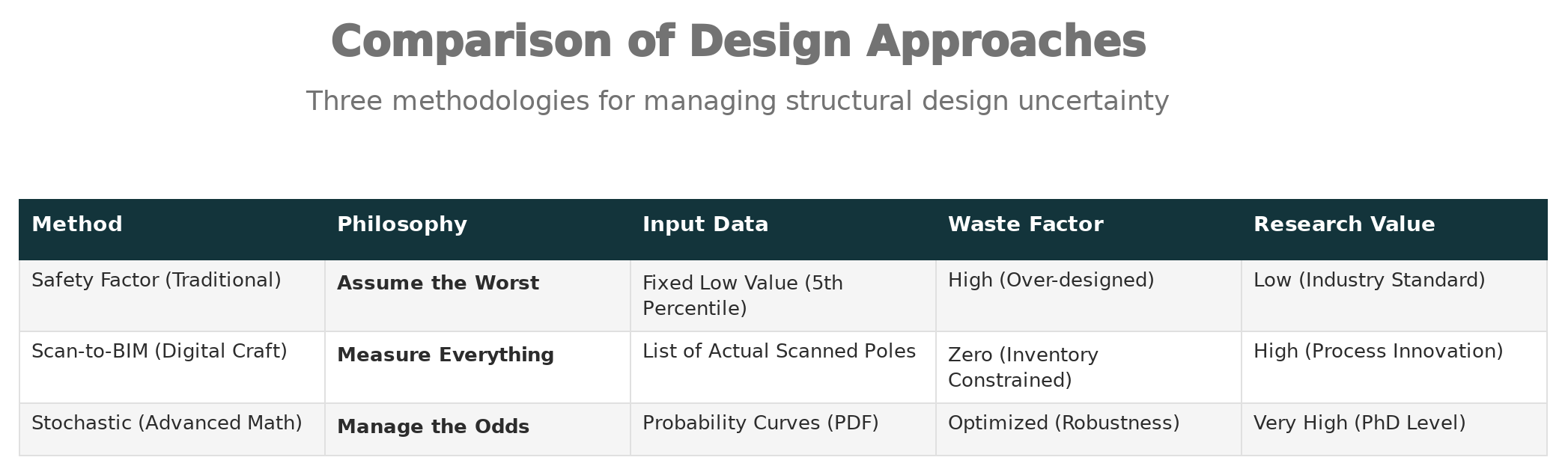
Evolution of Computational Strategy. A comparison of the three dominant approaches to material uncertainty. While ‘Safety Factors’ remain the industry standard for compliance, ‘Stochastic Optimization’ offers the highest research value for maximizing structural efficiency without compromising robustness.
As we move forward in 2026, my research will be heading in this direction. I want to move away from drawing “ideal” shapes and start coding “robust” systems. Because in the end, architecture shouldn’t be about fighting nature’s chaos. It should be about finding the order within it.
Reference
[1] R. E. Melchers and T. Beck, *Structural Reliability Analysis and Prediction*, 3rd ed. Chichester, UK: John Wiley & Sons, 2018.
[2] M. Papadrakakis, V. Papadopoulos, and N. D. Lagaros, “Structural reliability analysis of elastic-plastic structures using neural networks and Monte Carlo simulation,” *Computer Methods in Applied Mechanics and Engineering*, vol. 136, no. 1-2, pp. 145-163, 1996.
[3] S. S. Rao, “Engineering Optimization: Theory and Practice,” 4th ed. Hoboken, NJ: John Wiley & Sons, 2009.
[4] F. Faris, “Reliability analysis of WBM MSE wall based on tensile strength variation,” *ASEAN Engineering Journal*, vol. 12, no. 4, pp. 15-22, 2022. Available: https://journals.utm.my/aej/article/download/17320/7866
[5] G. I. Schuëller, “On the treatment of uncertainties in structural mechanics and analysis,” *Computers & Structures*, vol. 85, no. 5-6, pp. 235-243, 2007.
[6] H.-G. Beyer and B. Sendhoff, “Robust optimization – A comprehensive survey,” *Computer Methods in Applied Mechanics and Engineering*, vol. 196, no. 33-34, pp. 3190-3218, 2007. Available: https://doi.org/10.1016/j.cma.2007.03.003
[7] P. Faber, “Robust design optimization of structures under uncertainties,” in *Proceedings of the 12th International Conference on Applications of Statistics and Probability in Civil Engineering (ICASP12)*, Vancouver, Canada, 2015.