The Lie of the Perfect Cylinder (Part 3): Embracing Chaos (Stochastic Optimization)

Why do bridges fall down? Why do roofs collapse? Usually, it’s not because the engineer got the average math wrong. It’s because of an “outlier.” A single joint that was weaker than expected, or a load event that exceeded the “average” prediction [1].

In traditional design, we fear these outliers. We try to hide from them behind huge Safety Factors (as discussed in Part 1).

But in Stochastic Optimization, we don’t hide. We invite the outliers into the model. We design specifically for the chaos. This approach, widely used in aerospace and financial engineering, is the frontier of structural design for natural materials [2].

In a standard Grasshopper script, a number is a scalar value: `Diameter = 10`.
In a Stochastic script, a number is a Probability Density Function (PDF) [3].

Instead of telling the computer “Bamboo is 10cm thick,” we tell it:
“Bamboo is a bell curve. It is usually 10cm. Sometimes (68% of the time) it is between 9cm and 11cm. Rarely (1% of the time) it is 7cm.”

This is a much more honest way to describe nature. Natural materials like bamboo do not have a single “strength” value; they exhibit statistical variability that follows specific distribution patterns (often Weibull or Normal distributions) [4].

So, how do we optimize for a “curve”? We use a brute-force method called the Monte Carlo Simulation [5].

Imagine we have a design for a bamboo truss. To test if it is robust, the computer plays a game of dice.

The Iteration Loop:
The computer builds a virtual model of our truss. But for every single strut, it randomly assigns properties based on our probability curve [5].

  • Strut A gets assigned “Weak.”
  • Strut B gets assigned “Average.”
  • Strut C gets assigned “Strong.”

The Stress Test:
It applies the load. Does the truss break?

Repeat x 1000:
It resets and tries again with new random values. It does this 1,000 or 5,000 times.

The Result:
We don’t get a simple “Pass/Fail” result. We get a Probability of Failure (Pf).
“This design failed in 4 out of 1000 simulations. It has a 99.6% Reliability Index.”

Now, we hook this into our Genetic Algorithm (Galapagos or Wallacei).

Usually, GA looks for the lightest structure. But a Stochastic GA looks for the most Robust structure [6].

What is robustness?
A “Strong” structure might hold a heavy load, but if one member is slightly weak, it collapses. A “Robust” structure is resilient. It has redundancy. If one bamboo pole is weaker than expected, the forces redistribute to its neighbors. The structure survives. This concept is critical for bamboo, where local defects are common [7].

This brings us to the end of our three-part exploration on “The Lie of the Perfect Cylinder.”

  • Part 1 showed us that Safety Factors are safe but wasteful. They treat bamboo like bad steel.
  • Part 2 showed us that Scan-to-BIM is precise but logistically difficult.
  • Part 3 showed us that Stochastic Design is the mathematical middle ground. It allows us to design safe, efficient structures by embracing the statistical reality of nature.
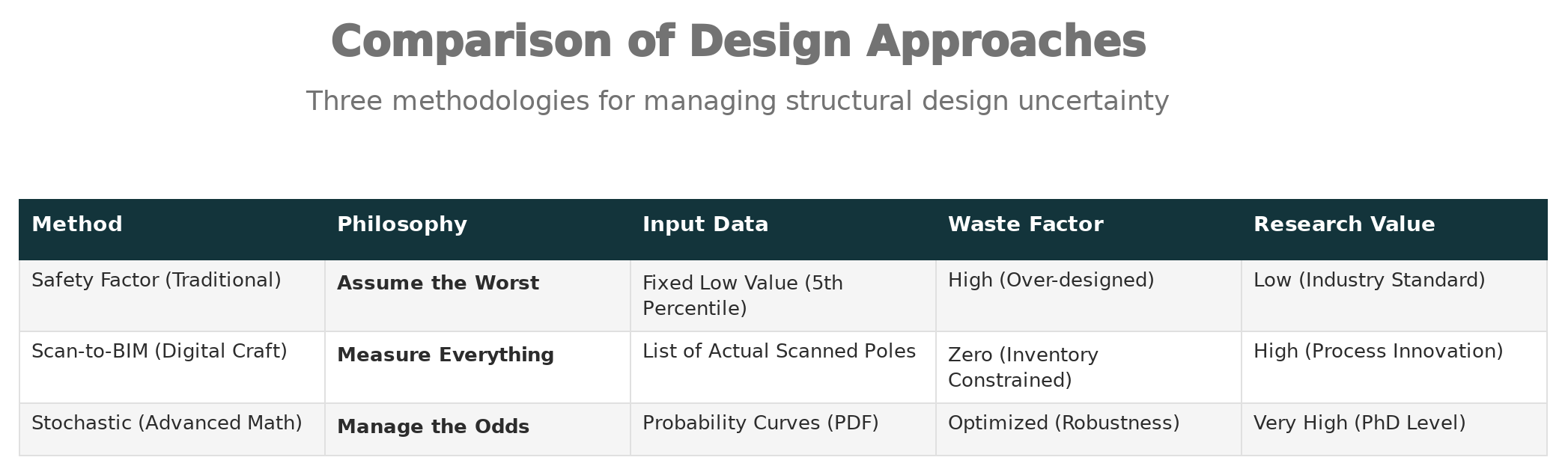
Evolution of Computational Strategy. A comparison of the three dominant approaches to material uncertainty. While ‘Safety Factors’ remain the industry standard for compliance, ‘Stochastic Optimization’ offers the highest research value for maximizing structural efficiency without compromising robustness.

As we move forward in 2026, my research will be heading in this direction. I want to move away from drawing “ideal” shapes and start coding “robust” systems. Because in the end, architecture shouldn’t be about fighting nature’s chaos. It should be about finding the order within it.

Reference

[1] R. E. Melchers and T. Beck, *Structural Reliability Analysis and Prediction*, 3rd ed. Chichester, UK: John Wiley & Sons, 2018.

[2] M. Papadrakakis, V. Papadopoulos, and N. D. Lagaros, “Structural reliability analysis of elastic-plastic structures using neural networks and Monte Carlo simulation,” *Computer Methods in Applied Mechanics and Engineering*, vol. 136, no. 1-2, pp. 145-163, 1996.

[3] S. S. Rao, “Engineering Optimization: Theory and Practice,” 4th ed. Hoboken, NJ: John Wiley & Sons, 2009.

[4] F. Faris, “Reliability analysis of WBM MSE wall based on tensile strength variation,” *ASEAN Engineering Journal*, vol. 12, no. 4, pp. 15-22, 2022. Available: https://journals.utm.my/aej/article/download/17320/7866

[5] G. I. Schuëller, “On the treatment of uncertainties in structural mechanics and analysis,” *Computers & Structures*, vol. 85, no. 5-6, pp. 235-243, 2007.

[6] H.-G. Beyer and B. Sendhoff, “Robust optimization – A comprehensive survey,” *Computer Methods in Applied Mechanics and Engineering*, vol. 196, no. 33-34, pp. 3190-3218, 2007. Available: https://doi.org/10.1016/j.cma.2007.03.003

[7] P. Faber, “Robust design optimization of structures under uncertainties,” in *Proceedings of the 12th International Conference on Applications of Statistics and Probability in Civil Engineering (ICASP12)*, Vancouver, Canada, 2015.

The Lie of the Perfect Cylinder (Part 2): Designing with Reality (Scan-to-BIM)

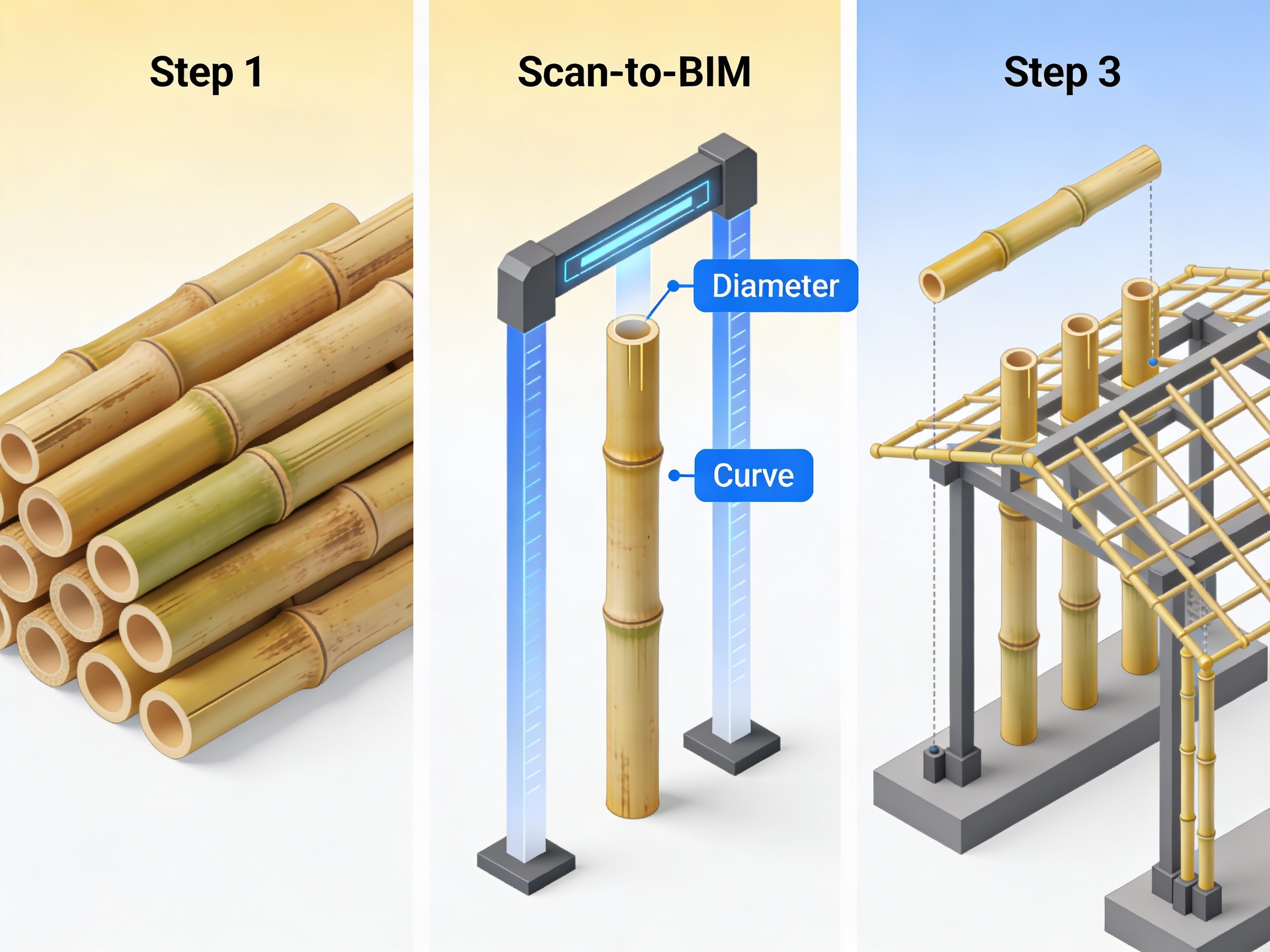
The Inventory-Constrained Workflow. Instead of imposing a geometry onto the material, the design process begins with digitization. 1) The raw material is harvested. 2) Each pole is scanned to create a ‘Digital Twin’. 3) Algorithms assign specific poles to structural members based on their unique geometric properties, minimizing waste.

Imagine a chef planning a menu. In the traditional way, he dreams up a dish (say, Lobster Thermidor) and then sends his staff out to find lobsters. If they can’t find perfect lobsters, the dish fails. In the sustainable way, the chef opens the fridge first. He sees he has excellent carrots, some fresh snapper, and wild spinach. He creates a menu based on those ingredients.

Architects are usually the first type of chef. We dream of a shape, and then we demand materials that fit. But with bio-based materials like bamboo, which are defined by their irregularity, we need to be the second type [1]. We need to design for the inventory we actually have.

This is the core concept of Inventory-Constrained Design, sometimes referred to in advanced research as “Scan-to-BIM” or data-driven material assignment [2].

How do we actually do this? It sounds like magic, but it is just data management.

Step 1: The Digital Inventory
Before we design, we scan. Advanced research labs like CITA (Centre for Information Technology and Architecture) have demonstrated workflows where individual timber or bamboo elements are scanned to capture their exact geometry [3].
In Medan, we can use simpler tools. We measure 500 poles and record their specific metrics: Length, Base Diameter, Top Diameter, and Curvature Deviation.

We import this data into Grasshopper. Now, my script doesn’t just have a generic “cylinder” component. It has a List of 500 unique objects, each with its own structural personality. This process effectively creates a “Digital Twin” of our material stock [4].

Step 2: The Matchmaker Algorithm
This is where the computational magic happens. We run a script that analyzes our structural skeleton.

  • “Member A” is under high compression (10kN).
  • “Member B” is just a bracing element (low stress).

The algorithm then searches our “Digital Fridge” (the inventory database). It assigns the thickest, straightest pole (e.g., ID #042) to “Member A,” and a thinner, slightly curved pole (e.g., ID #105) to “Member B” [5]. This optimization technique, known as the “Assignment Problem” in operations research, ensures the best possible use of available resources [2].

Step 3: The Feedback Loop
If the algorithm can’t find a pole strong enough for a specific beam, it doesn’t fake it. It tells the design engine: “Change the shape! We don’t have the bamboo for this span.” The form adapts to the material availability.

This workflow fundamentally changes our relationship with waste.

In a standard project, if a pole is slightly crooked, it gets rejected. It becomes firewood. In a Scan-to-BIM workflow, that crooked pole is valuable. The algorithm finds the one place in the roof curve where a bent pole is actually perfect. This approach maximizes the utility of every single harvested culm, aligning with principles of the Circular Economy [6].

The Structural Truth:
Furthermore, our structural analysis becomes incredibly precise. When we run the simulation in Karamba3D, we aren’t guessing the diameter. We are using the actual scanned diameter of the specific pole assigned to that node, significantly reducing the “Model Uncertainty” typically associated with natural materials [5].

Of course, this is logistically heavy. It requires tagging every pole with a QR code and managing a complex database [3]. It turns the architect into a logistics manager.

But for high-performance structures, this is the future. It allows us to build complex, verified structures with irregular natural materials.

But… what if you don’t have time to scan 1,000 poles? What if you are designing a prototype and haven’t bought the material yet? Is there a way to be accurate without being obsessive? Yes. We turn to mathematics.

Next Week: Part 3: The Power of Probability (Stochastic Optimization).

Reference

[1] M. Tamke, M. Ramsgaard Thomsen, and A. Cavallo, “The raw and the cooked – Designing with irregular wood,” in Paradigm Shift: Proceedings of the 35th Annual Conference of ACADIA, 2015, pp. 265-274. Available: http://papers.cumincad.org/cgi-bin/works/Show?_id=acadia15_265

[2] A. Bukauskas, P. Shepherd, P. Mayencourt, C. Mueller, and P. Walker, “Inventory-constrained structural design: New objectives and methods,” Proceedings of the IASS Symposium, Boston, 2018. Available: https://people.bath.ac.uk/ps281/research/publications/boston_preprint3.pdf

[3] A. Cavallo, “High-Tech Low-Tech: Strategies for wood construction,” Journal of Architectural Engineering and Technology, vol. 6, no. 1, 2017.

[4] C. Gengnagel, E. Kilian, N. Palz, and F. Scheurer, Computational Design and Digital Fabrication. Cham: Springer International Publishing, 2018.

[5] Z. Yang et al., “Automated Scan-to-BIM modeling of bamboo structures using deep learning,” Automation in Construction, vol. 142, p. 104523, 2022.

[6] D. E. Hebel and F. Heisel, “Cultivated building materials: Industrialized natural resources for architecture and construction,” Birkhäuser, 2017.

The Lie of the Perfect Cylinder (Part 1): Why “Safety Factors” Are Killing Bamboo Design

The Material Gap. On the left, the idealized ‘pipe’ used in standard structural analysis softwares like Karamba3D. On the right, the reality of Dendrocalamus asper: tapered, non-uniform, and biologically complex. Closing this gap is the primary challenge of computational bamboo design.

If you look at my computer screen right now, you will see a beautiful bamboo pavilion. In the Rhino viewport, the structure is elegant. The lines are clean. The joints are perfect intersections. But as architects, we must be wary of “idealized digital models” that do not reflect material reality [1].

In the logic of my Grasshopper script, every structural member is defined as a “pipe.”

  • Radius: 50mm
  • Thickness: 10mm
  • Young’s Modulus (Stiffness): 18,000 MPa

The computer loves this. It calculates the stress, shows me a nice colorful gradient of forces, and tells me the building is safe. But this is a lie.

In reality, the bamboo sitting in the storage yard is not a pipe. It is a biological organism with significant heterogeneity [2]. It tapers (getting thinner at the top), it is not perfectly round, and its material properties vary wildly along the culm [3]. One pole might be stiff and strong; the neighbor pole, cut from the same clump, might be 20% weaker due to density variations [4].

So, how do engineers solve this gap between the “Digital Ideal” and the “Natural Reality”? Usually, they use a blunt instrument called the Safety Factor.

The standard engineering approach to uncertainty is simple: Assume the worst.

When we design with steel, we know exactly how it will behave because it is a standardized industrial product. When we design with bamboo, we consult standards like ISO 22156:2021 (Bamboo structures — Bamboo culms — Structural design) [5].

This code mandates the use of the “Characteristic Strength,” which is defined as the 5th percentile value of the tested population [5].
Translation: If you test 100 poles, you must ignore the strength of the top 95. You base your entire design on the statistical strength of the 5 weakest ones.

Then, we divide that number again by a partial safety factor, which is derived from “best available engineering judgement” to account for material unpredictability [5].

The Computational Consequence:
In my Karamba3D script, this means I have to input a fictitious material. Even if I know my Dendrocalamus asper (Petung) has an average modulus of elasticity (MOE) of 17,000 MPa [2], I might have to input 8,000 MPa just to be compliant with the standard.

You might ask: “So what? Better safe than sorry, right?”

For safety? Yes. For optimization? No. When we feed these “crippled” numbers into a Genetic Algorithm (like Galapagos or Wallacei), we effectively break the optimization loop.

  1. The Bulky Result:
    The algorithm sees that the material is “weak” (mathematically), so it compensates by adding mass. It generates heavy, dense structures that resemble timber bunkers rather than lightweight bamboo pavilions, negating bamboo’s high strength-to-weight ratio [6].
  2. The Carbon Cost:
    Over-designing isn’t just an aesthetic crime; it’s an environmental one. Using 30% more material than necessary “just to be safe” increases the embodied carbon and resource extraction of the project [6].
  3. The “Lazy” Solution:
    Safety factors stop us from asking harder questions. They allow us to remain ignorant about our material. Instead of trying to quantify the specific performance of our inventory, we just downgrade the math.

We cannot simply abandon safety factors – we have a responsibility to public safety. But in the world of Computational Design, we should demand more precision.

If we want to build structures that are truly optimized – that use the least amount of material to achieve the maximum strength  – we need to stop treating bamboo like “bad steel.” We need to treat it like a unique biological asset.

We need to stop assuming. We need to start measuring.

In the next post, I will explore a workflow that flips the script completely: What if we didn’t design the shape first? What if we scanned the bamboo first, and let the material dictate the form?

Next Week: Part 2: The Scan-to-BIM Revolution – Designing with Inventory.

References

[1] R. Oxman, “Theory and design in the first digital age,” *Design Studies*, vol. 27, no. 3, pp. 229-265, 2006. Available: https://doi.org/10.1016/j.destud.2005.11.002

[2] A. Javadian, F. Smith-Gillespie, K. E. H. Kubilay, and D. E. Hebel, “Mechanical properties of bamboo through measurement of culm physical properties for composite fabrication of structural concrete reinforcement,” *Frontiers in Materials*, vol. 6, p. 15, 2019. Available: https://doi.org/10.3389/fmats.2019.00015

[3] R. Hartono et al., “Physical, chemical, and mechanical properties of six bamboo species from the forest area with special purpose (FASP),” *Forests*, vol. 13, no. 11, p. 1893, 2022. Available: https://doi.org/10.3390/f13111893

[4] D. Trujillo and M. Ramage, “Latitudinal bending stiffness of bamboo culms,” *Proceedings of the Institution of Civil Engineers – Structures and Buildings*, vol. 170, no. 1, pp. 59-67, 2017.

[5] *Bamboo structures — Bamboo culms — Structural design*, ISO 22156:2021, International Organization for Standardization, Geneva, 2021. Available: https://www.iso.org/standard/73831.html

[6] G. Habert et al., “Environmental impacts and decarbonization strategies in the cement and concrete industries,” *Nature Reviews Earth & Environment*, vol. 1, no. 11, pp. 559-573, 2020. Available: https://doi.org/10.1038/s43017-020-0093-3

My First Year Mapping the Intersection of Code and Climate

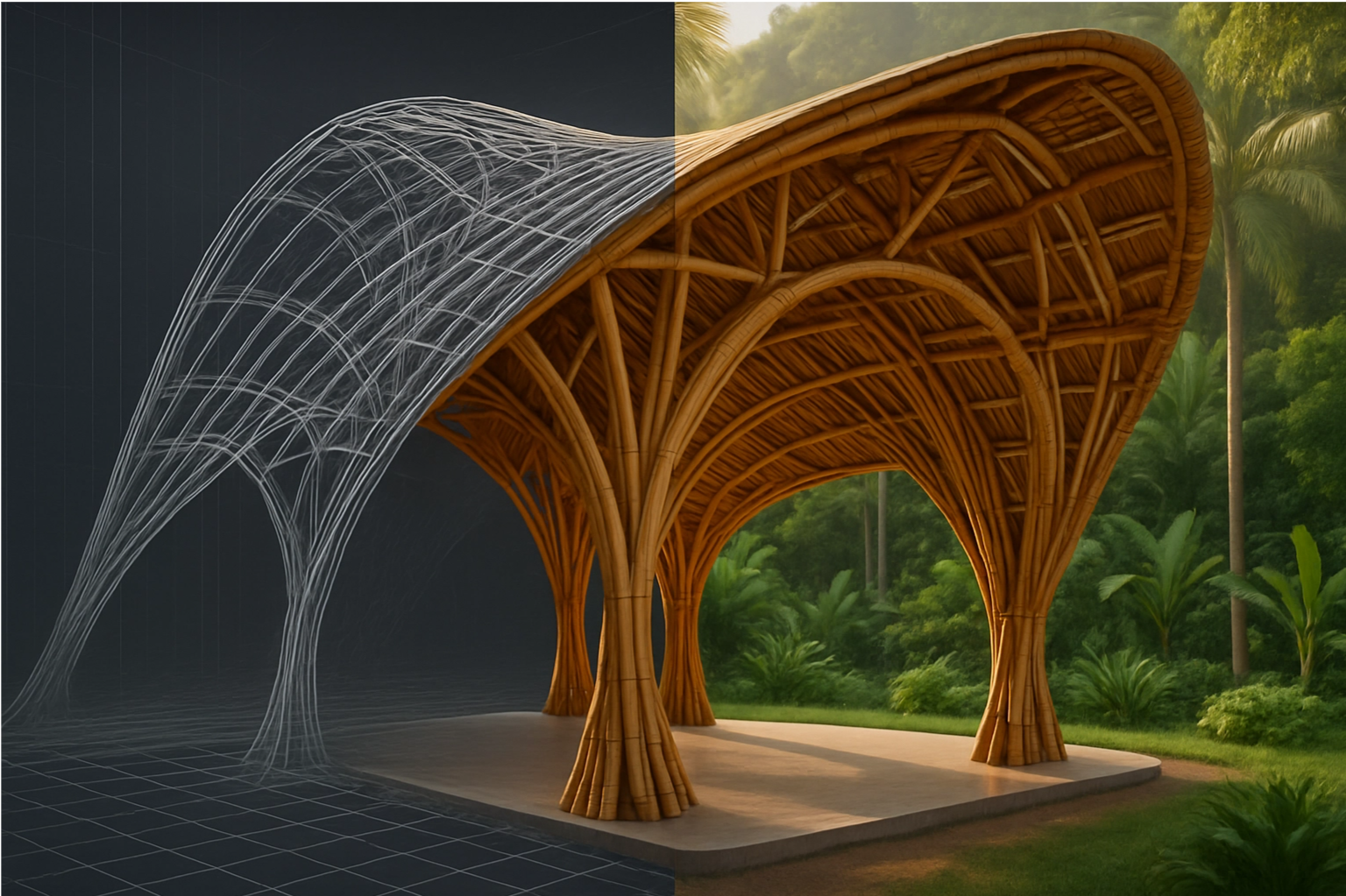
building structure transitioning from a digital parametric wireframe into a real-world bamboo pavilion

Consistency is often more difficult than intensity. It is easy to sprint; it is hard to walk every day for a year.

Today marks a small but meaningful milestone for me: I have successfully published a blog post every single month for the past 12 months. One year of consistent writing.

To some, this might seem trivial. It’s just a blog, right? But for me, this represents a discipline I’ve been trying to cultivate. In a world of instant updates and fleeting social media stories, the act of sitting down to write a thoughtful, long-form piece once a month feels like an act of resistance. It’s a commitment to deep thinking over quick scrolling.

When I started this commitment a year ago, I had a few hopes.

For Myself: Writing forces clarity. You think you understand a concept—like computational design or sustainable bamboo construction—until you try to explain it to someone else. Writing these posts has been my best method of study. It forces me to research deeper, structure my thoughts, and articulate my arguments.

For My Students: I wanted to create a resource that extends beyond the classroom. A lecture lasts 100 minutes, but a blog post lasts forever. Students can revisit these ideas about parametric design, environmental responsibility, or professional ethics whenever they need them.

For the Institution: I hope this blog contributes, in a small way, to the scientific culture of Universitas Medan Area. Academic discourse shouldn’t just happen in closed journals; it should be accessible, public, and engaging.

For the Public: Architecture can feel elitist or inaccessible. I try to write in a way that bridges the gap – making complex ideas about resilient cities or design technology understandable to anyone who cares about the built environment.

Looking back at the archive, I see a map of my own intellectual journey this year.

We explored computational design – demystifying Grasshopper not just as a tool for making weird shapes, but as a way to think algorithmically.

We dived into bamboo architecture, discussing how traditional materials can be optimized with modern technology.

We tackled climate resilience, especially after the floods of November. The post “Designing for Cyclones” wasn’t just an article; it was a response to a real crisis we all faced.

We reflected on education, asking hard questions about why hydrology isn’t foundational in design schools.

Each post was a snapshot of what I was learning, questioning, or fighting for at that moment.

I don’t know who reads every post. Analytics give numbers, but they don’t tell stories.

But then, something surprising happened in October.

Someone approached me on campus – someone I didn’t know – specifically to discuss bamboo. They weren’t a student in my class, but they had read my blog post about bamboo construction joints. They came with specific questions, ready to discuss preservation techniques and structural details.

I was genuinely surprised.

To be honest, sometimes writing a blog feels like shouting into the void. You press “publish” and wonder if anyone actually cares. But that conversation in October proved that words travel. It proved that there are people out there – students, practitioners, enthusiasts – who are hungry for this kind of specific, technical knowledge.

That moment was a turning point for me. It shifted my perspective from “I have to write this for my schedule” to “I get to write this for a community.”

It is the best kind of reward. Not the traffic numbers, but the real, human connection that starts with a shared idea.

I hope this blog serves as a small spark.
A spark for students to read more than just captions.
A spark for colleagues to share their own expertise publicly.
A spark for anyone to start writing their own thoughts.

Because knowledge that isn’t shared is knowledge that stagnates. Writing keeps it moving.

So, here is to consistency.

To showing up at the keyboard even when I’m tired.
To researching topics that challenge me.
To pressing “Publish” even when I’m not sure if it’s perfect.

Thank you to everyone who has read, shared, or discussed these posts over the last year. You are the reason I keep writing.

Let’s see what the next 12 months will teach us.

Keep reading. Keep writing. Keep learning.

2026: Evaluation, Gratitude, And The Road Ahead

I don’t really “celebrate” New Year’s in the way most people do. No fireworks, no loud parties, no countdowns at midnight. For me, the turning of the year is quieter, more internal. It’s a moment of syukur (deep gratitude) – a pause to acknowledge that, Alhamdulillah, we made it through.

2025 was a year of heavy lessons. Floods that devastated our city. Field trips that restored my hope. We survived it all.

So instead of a celebration, today is an evaluation. I’m sitting, looking back at what worked and what didn’t, and writing down hopes for 2026. Not resolutions – which often feel like burdens we abandon by February – but hopes. Hopes feel like a compass; they give us direction.

This year, my compass points toward three specific mountains I want to climb.

“We must be willing to let go of the life we planned so as to have the life that is waiting for us.” — Joseph Campbell

First, a professional milestone closer to home. This year, I am setting my sights on the next significant step in my academic career: achieving the rank of Lektor Kepala (Associate Professor).

To some, this might sound like just administrative jargon or a title chase. But in the world of academia, rank is about capacity and voice. It’s about having the standing to advocate more effectively for the things I care about – curriculum reform and building a true scientific culture.

Becoming an Associate Professor means my research on computational design and disaster resilience carries more weight. It validates the work I’ve been doing on bamboo, on flood mitigation, on educational reform. It opens doors for more significant grants and collaborations.

It’s a steep climb. The administrative requirements (Kum), the publications, the teaching load – it’s a rigorous process. But it’s a necessary step. I want to lead by example for my junior colleagues and my students: that we must constantly upgrade ourselves, not for the title, but for the impact that title allows us to make.

“Intelligence plus character – that is the goal of true education.” — Martin Luther King, Jr.

Beyond the title, there is the hunger for knowledge. The quiet ambition that won’t go away: to continue my studies abroad.

I want to dive deep into the specific intersection of architecture that obsesses me – where computational design meets sustainability.

Why abroad? It’s not because I don’t love Indonesia. It’s because I love it that I need to go. I need to see how other cultures solve the unsolvable. I want to be in studios where “sustainable” isn’t a buzzword but a mathematical mandate. I want to argue about algorithms and ecology with people who don’t think those two things are opposites.

This isn’t just about getting another degree. It’s about sharpening my tools. Because when I return, I don’t want to just be an architect who designs buildings. I want to be an architect who designs solutions for the complex, climate-changed reality of North Sumatra.

But these personal dreams – rank and degrees – are ultimately about service. They are about the students I see every week in studio.

I look at them – struggling with bamboo joints, wrestling with site plans – and I see so much potential. My goal is to bring back knowledge and authority that transforms them.

I want to produce graduates who are “tangguh” (resilient).

I want students who don’t just ask “How high can I build?” but “How does this building heal the land?”

I want them to be competitive globally, armed with the latest computational tools, but grounded locally, with empathy for the environment. Imagine a generation of North Sumatran architects who can code a parametric facade and understand the water table of a peatland. That’s the legacy I want to build.

“Education is the most powerful weapon which you can use to change the world.” — Nelson Mandela

Finally, there is my studio practice.

I envision a professional service that walks the talk. I don’t want my studio to just be a place where we draft blueprints. I want it to be a laboratory for sustainable computational design.

I want to prove that we can design buildings that are data-driven yet deeply human. Buildings that use algorithms to minimize waste. Buildings that fit into their environment so perfectly, they feel like they grew there.

This is the professional service I want to offer: architecture that is responsible, cutting-edge, and respectful of nature. No more “business as usual” design that ignores the climate crisis. We need to build better.

“As an architect you design for the present, with an awareness of the past, for a future which is essentially unknown.” — Norman Foster

So, here it is. Written down so I can’t run away from it.

2026 is about elevation. Elevating my rank to Lektor Kepala. Elevating my knowledge through further study. Elevating my students’ capacity. Elevating my professional practice.

It’s scary to say these things out loud. The path to Associate Professor is hard. Applying for PhDs abroad is daunting. Running a sustainable studio is risky.

But looking back at 2025 – at the floods, at the resilience of nature, at the eyes of the orangutans we visited – I know that staying comfortable is not an option.

We have work to do.

Bismillah. Let’s make this year count.