
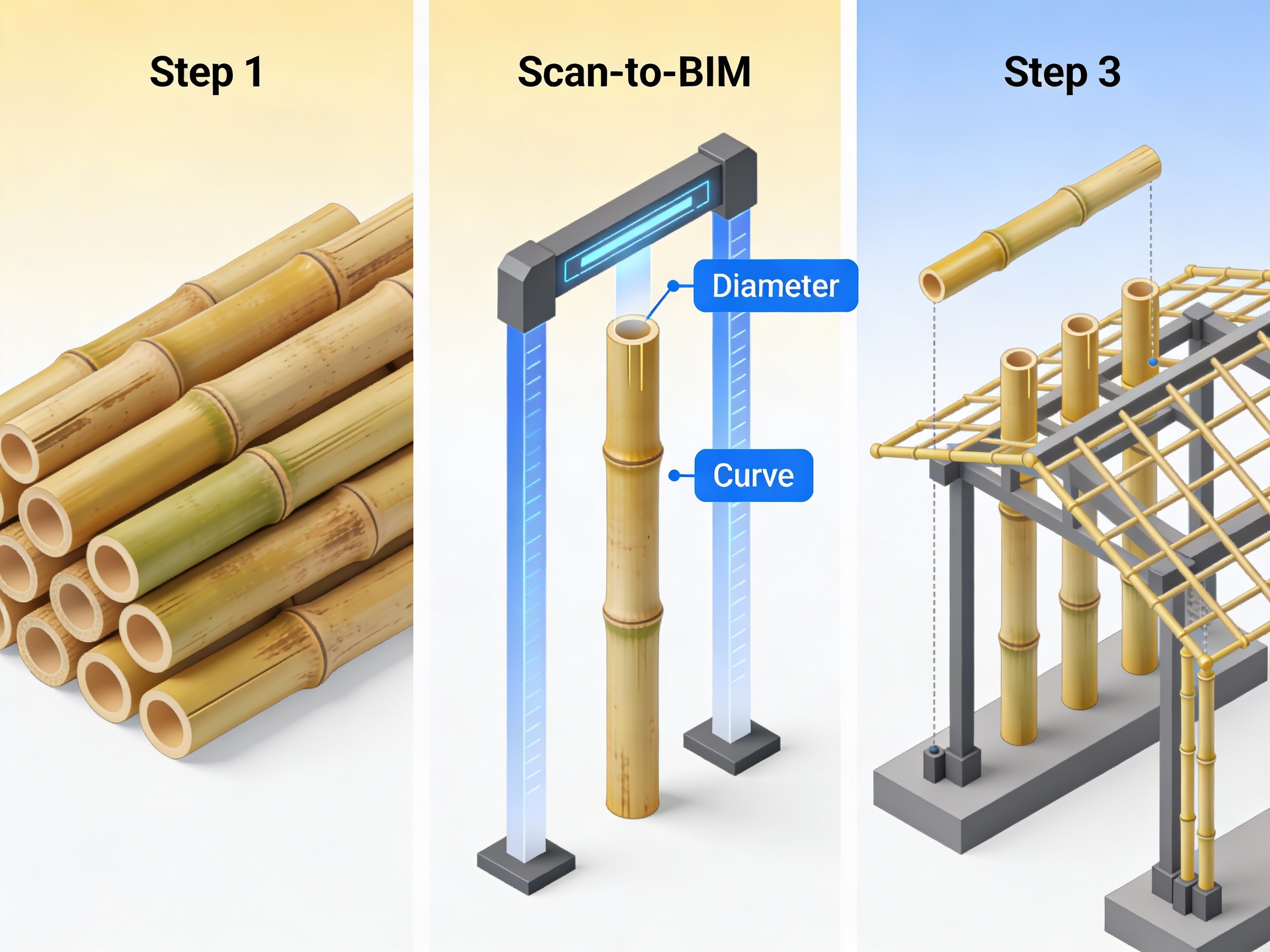
The Inventory-Constrained Workflow. Instead of imposing a geometry onto the material, the design process begins with digitization. 1) The raw material is harvested. 2) Each pole is scanned to create a ‘Digital Twin’. 3) Algorithms assign specific poles to structural members based on their unique geometric properties, minimizing waste.
Imagine a chef planning a menu. In the traditional way, he dreams up a dish (say, Lobster Thermidor) and then sends his staff out to find lobsters. If they can’t find perfect lobsters, the dish fails. In the sustainable way, the chef opens the fridge first. He sees he has excellent carrots, some fresh snapper, and wild spinach. He creates a menu based on those ingredients.
Architects are usually the first type of chef. We dream of a shape, and then we demand materials that fit. But with bio-based materials like bamboo, which are defined by their irregularity, we need to be the second type [1]. We need to design for the inventory we actually have.
This is the core concept of Inventory-Constrained Design, sometimes referred to in advanced research as “Scan-to-BIM” or data-driven material assignment [2].
How do we actually do this? It sounds like magic, but it is just data management.
Step 1: The Digital Inventory
Before we design, we scan. Advanced research labs like CITA (Centre for Information Technology and Architecture) have demonstrated workflows where individual timber or bamboo elements are scanned to capture their exact geometry [3].
In Medan, we can use simpler tools. We measure 500 poles and record their specific metrics: Length, Base Diameter, Top Diameter, and Curvature Deviation.
We import this data into Grasshopper. Now, my script doesn’t just have a generic “cylinder” component. It has a List of 500 unique objects, each with its own structural personality. This process effectively creates a “Digital Twin” of our material stock [4].
Step 2: The Matchmaker Algorithm
This is where the computational magic happens. We run a script that analyzes our structural skeleton.
- “Member A” is under high compression (10kN).
- “Member B” is just a bracing element (low stress).
The algorithm then searches our “Digital Fridge” (the inventory database). It assigns the thickest, straightest pole (e.g., ID #042) to “Member A,” and a thinner, slightly curved pole (e.g., ID #105) to “Member B” [5]. This optimization technique, known as the “Assignment Problem” in operations research, ensures the best possible use of available resources [2].
Step 3: The Feedback Loop
If the algorithm can’t find a pole strong enough for a specific beam, it doesn’t fake it. It tells the design engine: “Change the shape! We don’t have the bamboo for this span.” The form adapts to the material availability.
This workflow fundamentally changes our relationship with waste.
In a standard project, if a pole is slightly crooked, it gets rejected. It becomes firewood. In a Scan-to-BIM workflow, that crooked pole is valuable. The algorithm finds the one place in the roof curve where a bent pole is actually perfect. This approach maximizes the utility of every single harvested culm, aligning with principles of the Circular Economy [6].
The Structural Truth:
Furthermore, our structural analysis becomes incredibly precise. When we run the simulation in Karamba3D, we aren’t guessing the diameter. We are using the actual scanned diameter of the specific pole assigned to that node, significantly reducing the “Model Uncertainty” typically associated with natural materials [5].
Of course, this is logistically heavy. It requires tagging every pole with a QR code and managing a complex database [3]. It turns the architect into a logistics manager.
But for high-performance structures, this is the future. It allows us to build complex, verified structures with irregular natural materials.
But… what if you don’t have time to scan 1,000 poles? What if you are designing a prototype and haven’t bought the material yet? Is there a way to be accurate without being obsessive? Yes. We turn to mathematics.
Next Week: Part 3: The Power of Probability (Stochastic Optimization).
Reference
[1] M. Tamke, M. Ramsgaard Thomsen, and A. Cavallo, “The raw and the cooked – Designing with irregular wood,” in Paradigm Shift: Proceedings of the 35th Annual Conference of ACADIA, 2015, pp. 265-274. Available: http://papers.cumincad.org/cgi-bin/works/Show?_id=acadia15_265
[2] A. Bukauskas, P. Shepherd, P. Mayencourt, C. Mueller, and P. Walker, “Inventory-constrained structural design: New objectives and methods,” Proceedings of the IASS Symposium, Boston, 2018. Available: https://people.bath.ac.uk/ps281/research/publications/boston_preprint3.pdf
[3] A. Cavallo, “High-Tech Low-Tech: Strategies for wood construction,” Journal of Architectural Engineering and Technology, vol. 6, no. 1, 2017.
[4] C. Gengnagel, E. Kilian, N. Palz, and F. Scheurer, Computational Design and Digital Fabrication. Cham: Springer International Publishing, 2018.
[5] Z. Yang et al., “Automated Scan-to-BIM modeling of bamboo structures using deep learning,” Automation in Construction, vol. 142, p. 104523, 2022.
[6] D. E. Hebel and F. Heisel, “Cultivated building materials: Industrialized natural resources for architecture and construction,” Birkhäuser, 2017.