The Lie of the Perfect Cylinder (Part 2): Designing with Reality (Scan-to-BIM)

The Inventory-Constrained Workflow. Instead of imposing a geometry onto the material, the design process begins with digitization. 1) The raw material is harvested. 2) Each pole is scanned to create a ‘Digital Twin’. 3) Algorithms assign specific poles to structural members based on their unique geometric properties, minimizing waste.

Imagine a chef planning a menu. In the traditional way, he dreams up a dish (say, Lobster Thermidor) and then sends his staff out to find lobsters. If they can’t find perfect lobsters, the dish fails. In the sustainable way, the chef opens the fridge first. He sees he has excellent carrots, some fresh snapper, and wild spinach. He creates a menu based on those ingredients.

Architects are usually the first type of chef. We dream of a shape, and then we demand materials that fit. But with bio-based materials like bamboo, which are defined by their irregularity, we need to be the second type [1]. We need to design for the inventory we actually have.

This is the core concept of Inventory-Constrained Design, sometimes referred to in advanced research as “Scan-to-BIM” or data-driven material assignment [2].

How do we actually do this? It sounds like magic, but it is just data management.

Step 1: The Digital Inventory
Before we design, we scan. Advanced research labs like CITA (Centre for Information Technology and Architecture) have demonstrated workflows where individual timber or bamboo elements are scanned to capture their exact geometry [3].
In Medan, we can use simpler tools. We measure 500 poles and record their specific metrics: Length, Base Diameter, Top Diameter, and Curvature Deviation.

We import this data into Grasshopper. Now, my script doesn’t just have a generic “cylinder” component. It has a List of 500 unique objects, each with its own structural personality. This process effectively creates a “Digital Twin” of our material stock [4].

Step 2: The Matchmaker Algorithm
This is where the computational magic happens. We run a script that analyzes our structural skeleton.

  • “Member A” is under high compression (10kN).
  • “Member B” is just a bracing element (low stress).

The algorithm then searches our “Digital Fridge” (the inventory database). It assigns the thickest, straightest pole (e.g., ID #042) to “Member A,” and a thinner, slightly curved pole (e.g., ID #105) to “Member B” [5]. This optimization technique, known as the “Assignment Problem” in operations research, ensures the best possible use of available resources [2].

Step 3: The Feedback Loop
If the algorithm can’t find a pole strong enough for a specific beam, it doesn’t fake it. It tells the design engine: “Change the shape! We don’t have the bamboo for this span.” The form adapts to the material availability.

This workflow fundamentally changes our relationship with waste.

In a standard project, if a pole is slightly crooked, it gets rejected. It becomes firewood. In a Scan-to-BIM workflow, that crooked pole is valuable. The algorithm finds the one place in the roof curve where a bent pole is actually perfect. This approach maximizes the utility of every single harvested culm, aligning with principles of the Circular Economy [6].

The Structural Truth:
Furthermore, our structural analysis becomes incredibly precise. When we run the simulation in Karamba3D, we aren’t guessing the diameter. We are using the actual scanned diameter of the specific pole assigned to that node, significantly reducing the “Model Uncertainty” typically associated with natural materials [5].

Of course, this is logistically heavy. It requires tagging every pole with a QR code and managing a complex database [3]. It turns the architect into a logistics manager.

But for high-performance structures, this is the future. It allows us to build complex, verified structures with irregular natural materials.

But… what if you don’t have time to scan 1,000 poles? What if you are designing a prototype and haven’t bought the material yet? Is there a way to be accurate without being obsessive? Yes. We turn to mathematics.

Next Week: Part 3: The Power of Probability (Stochastic Optimization).

Reference

[1] M. Tamke, M. Ramsgaard Thomsen, and A. Cavallo, “The raw and the cooked – Designing with irregular wood,” in Paradigm Shift: Proceedings of the 35th Annual Conference of ACADIA, 2015, pp. 265-274. Available: http://papers.cumincad.org/cgi-bin/works/Show?_id=acadia15_265

[2] A. Bukauskas, P. Shepherd, P. Mayencourt, C. Mueller, and P. Walker, “Inventory-constrained structural design: New objectives and methods,” Proceedings of the IASS Symposium, Boston, 2018. Available: https://people.bath.ac.uk/ps281/research/publications/boston_preprint3.pdf

[3] A. Cavallo, “High-Tech Low-Tech: Strategies for wood construction,” Journal of Architectural Engineering and Technology, vol. 6, no. 1, 2017.

[4] C. Gengnagel, E. Kilian, N. Palz, and F. Scheurer, Computational Design and Digital Fabrication. Cham: Springer International Publishing, 2018.

[5] Z. Yang et al., “Automated Scan-to-BIM modeling of bamboo structures using deep learning,” Automation in Construction, vol. 142, p. 104523, 2022.

[6] D. E. Hebel and F. Heisel, “Cultivated building materials: Industrialized natural resources for architecture and construction,” Birkhäuser, 2017.

The Lie of the Perfect Cylinder (Part 1): Why “Safety Factors” Are Killing Bamboo Design

The Material Gap. On the left, the idealized ‘pipe’ used in standard structural analysis softwares like Karamba3D. On the right, the reality of Dendrocalamus asper: tapered, non-uniform, and biologically complex. Closing this gap is the primary challenge of computational bamboo design.

If you look at my computer screen right now, you will see a beautiful bamboo pavilion. In the Rhino viewport, the structure is elegant. The lines are clean. The joints are perfect intersections. But as architects, we must be wary of “idealized digital models” that do not reflect material reality [1].

In the logic of my Grasshopper script, every structural member is defined as a “pipe.”

  • Radius: 50mm
  • Thickness: 10mm
  • Young’s Modulus (Stiffness): 18,000 MPa

The computer loves this. It calculates the stress, shows me a nice colorful gradient of forces, and tells me the building is safe. But this is a lie.

In reality, the bamboo sitting in the storage yard is not a pipe. It is a biological organism with significant heterogeneity [2]. It tapers (getting thinner at the top), it is not perfectly round, and its material properties vary wildly along the culm [3]. One pole might be stiff and strong; the neighbor pole, cut from the same clump, might be 20% weaker due to density variations [4].

So, how do engineers solve this gap between the “Digital Ideal” and the “Natural Reality”? Usually, they use a blunt instrument called the Safety Factor.

The standard engineering approach to uncertainty is simple: Assume the worst.

When we design with steel, we know exactly how it will behave because it is a standardized industrial product. When we design with bamboo, we consult standards like ISO 22156:2021 (Bamboo structures — Bamboo culms — Structural design) [5].

This code mandates the use of the “Characteristic Strength,” which is defined as the 5th percentile value of the tested population [5].
Translation: If you test 100 poles, you must ignore the strength of the top 95. You base your entire design on the statistical strength of the 5 weakest ones.

Then, we divide that number again by a partial safety factor, which is derived from “best available engineering judgement” to account for material unpredictability [5].

The Computational Consequence:
In my Karamba3D script, this means I have to input a fictitious material. Even if I know my Dendrocalamus asper (Petung) has an average modulus of elasticity (MOE) of 17,000 MPa [2], I might have to input 8,000 MPa just to be compliant with the standard.

You might ask: “So what? Better safe than sorry, right?”

For safety? Yes. For optimization? No. When we feed these “crippled” numbers into a Genetic Algorithm (like Galapagos or Wallacei), we effectively break the optimization loop.

  1. The Bulky Result:
    The algorithm sees that the material is “weak” (mathematically), so it compensates by adding mass. It generates heavy, dense structures that resemble timber bunkers rather than lightweight bamboo pavilions, negating bamboo’s high strength-to-weight ratio [6].
  2. The Carbon Cost:
    Over-designing isn’t just an aesthetic crime; it’s an environmental one. Using 30% more material than necessary “just to be safe” increases the embodied carbon and resource extraction of the project [6].
  3. The “Lazy” Solution:
    Safety factors stop us from asking harder questions. They allow us to remain ignorant about our material. Instead of trying to quantify the specific performance of our inventory, we just downgrade the math.

We cannot simply abandon safety factors – we have a responsibility to public safety. But in the world of Computational Design, we should demand more precision.

If we want to build structures that are truly optimized – that use the least amount of material to achieve the maximum strength  – we need to stop treating bamboo like “bad steel.” We need to treat it like a unique biological asset.

We need to stop assuming. We need to start measuring.

In the next post, I will explore a workflow that flips the script completely: What if we didn’t design the shape first? What if we scanned the bamboo first, and let the material dictate the form?

Next Week: Part 2: The Scan-to-BIM Revolution – Designing with Inventory.

References

[1] R. Oxman, “Theory and design in the first digital age,” *Design Studies*, vol. 27, no. 3, pp. 229-265, 2006. Available: https://doi.org/10.1016/j.destud.2005.11.002

[2] A. Javadian, F. Smith-Gillespie, K. E. H. Kubilay, and D. E. Hebel, “Mechanical properties of bamboo through measurement of culm physical properties for composite fabrication of structural concrete reinforcement,” *Frontiers in Materials*, vol. 6, p. 15, 2019. Available: https://doi.org/10.3389/fmats.2019.00015

[3] R. Hartono et al., “Physical, chemical, and mechanical properties of six bamboo species from the forest area with special purpose (FASP),” *Forests*, vol. 13, no. 11, p. 1893, 2022. Available: https://doi.org/10.3390/f13111893

[4] D. Trujillo and M. Ramage, “Latitudinal bending stiffness of bamboo culms,” *Proceedings of the Institution of Civil Engineers – Structures and Buildings*, vol. 170, no. 1, pp. 59-67, 2017.

[5] *Bamboo structures — Bamboo culms — Structural design*, ISO 22156:2021, International Organization for Standardization, Geneva, 2021. Available: https://www.iso.org/standard/73831.html

[6] G. Habert et al., “Environmental impacts and decarbonization strategies in the cement and concrete industries,” *Nature Reviews Earth & Environment*, vol. 1, no. 11, pp. 559-573, 2020. Available: https://doi.org/10.1038/s43017-020-0093-3

My First Year Mapping the Intersection of Code and Climate

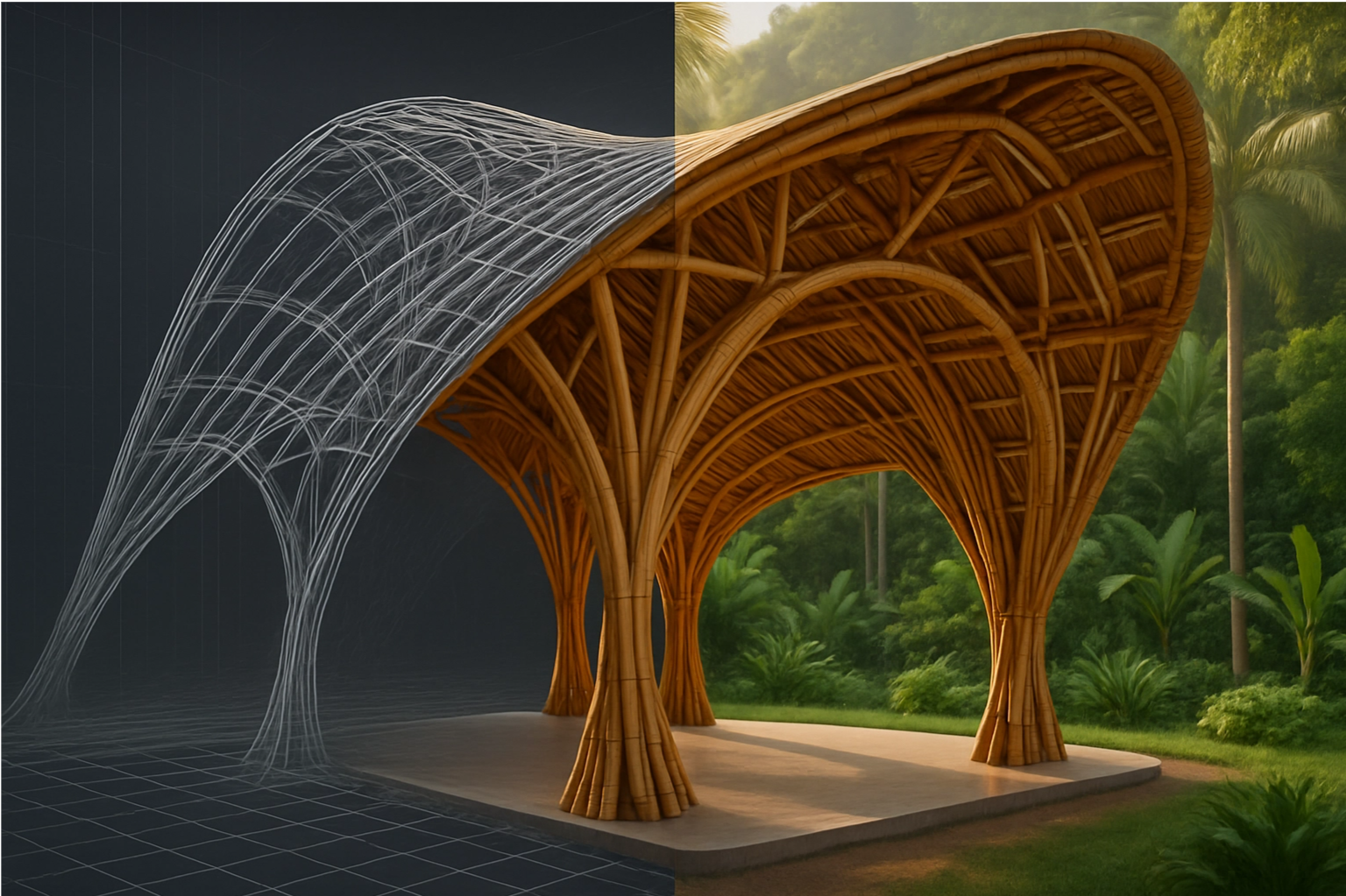
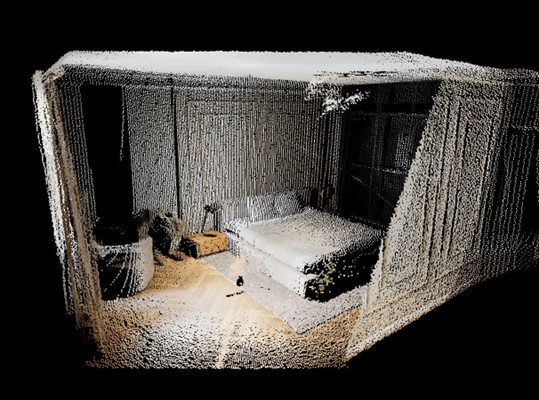
building structure transitioning from a digital parametric wireframe into a real-world bamboo pavilion

Consistency is often more difficult than intensity. It is easy to sprint; it is hard to walk every day for a year.

Today marks a small but meaningful milestone for me: I have successfully published a blog post every single month for the past 12 months. One year of consistent writing.

To some, this might seem trivial. It’s just a blog, right? But for me, this represents a discipline I’ve been trying to cultivate. In a world of instant updates and fleeting social media stories, the act of sitting down to write a thoughtful, long-form piece once a month feels like an act of resistance. It’s a commitment to deep thinking over quick scrolling.

When I started this commitment a year ago, I had a few hopes.

For Myself: Writing forces clarity. You think you understand a concept—like computational design or sustainable bamboo construction—until you try to explain it to someone else. Writing these posts has been my best method of study. It forces me to research deeper, structure my thoughts, and articulate my arguments.

For My Students: I wanted to create a resource that extends beyond the classroom. A lecture lasts 100 minutes, but a blog post lasts forever. Students can revisit these ideas about parametric design, environmental responsibility, or professional ethics whenever they need them.

For the Institution: I hope this blog contributes, in a small way, to the scientific culture of Universitas Medan Area. Academic discourse shouldn’t just happen in closed journals; it should be accessible, public, and engaging.

For the Public: Architecture can feel elitist or inaccessible. I try to write in a way that bridges the gap – making complex ideas about resilient cities or design technology understandable to anyone who cares about the built environment.

Looking back at the archive, I see a map of my own intellectual journey this year.

We explored computational design – demystifying Grasshopper not just as a tool for making weird shapes, but as a way to think algorithmically.

We dived into bamboo architecture, discussing how traditional materials can be optimized with modern technology.

We tackled climate resilience, especially after the floods of November. The post “Designing for Cyclones” wasn’t just an article; it was a response to a real crisis we all faced.

We reflected on education, asking hard questions about why hydrology isn’t foundational in design schools.

Each post was a snapshot of what I was learning, questioning, or fighting for at that moment.

I don’t know who reads every post. Analytics give numbers, but they don’t tell stories.

But then, something surprising happened in October.

Someone approached me on campus – someone I didn’t know – specifically to discuss bamboo. They weren’t a student in my class, but they had read my blog post about bamboo construction joints. They came with specific questions, ready to discuss preservation techniques and structural details.

I was genuinely surprised.

To be honest, sometimes writing a blog feels like shouting into the void. You press “publish” and wonder if anyone actually cares. But that conversation in October proved that words travel. It proved that there are people out there – students, practitioners, enthusiasts – who are hungry for this kind of specific, technical knowledge.

That moment was a turning point for me. It shifted my perspective from “I have to write this for my schedule” to “I get to write this for a community.”

It is the best kind of reward. Not the traffic numbers, but the real, human connection that starts with a shared idea.

I hope this blog serves as a small spark.
A spark for students to read more than just captions.
A spark for colleagues to share their own expertise publicly.
A spark for anyone to start writing their own thoughts.

Because knowledge that isn’t shared is knowledge that stagnates. Writing keeps it moving.

So, here is to consistency.

To showing up at the keyboard even when I’m tired.
To researching topics that challenge me.
To pressing “Publish” even when I’m not sure if it’s perfect.

Thank you to everyone who has read, shared, or discussed these posts over the last year. You are the reason I keep writing.

Let’s see what the next 12 months will teach us.

Keep reading. Keep writing. Keep learning.

2026: Evaluation, Gratitude, And The Road Ahead

I don’t really “celebrate” New Year’s in the way most people do. No fireworks, no loud parties, no countdowns at midnight. For me, the turning of the year is quieter, more internal. It’s a moment of syukur (deep gratitude) – a pause to acknowledge that, Alhamdulillah, we made it through.

2025 was a year of heavy lessons. Floods that devastated our city. Field trips that restored my hope. We survived it all.

So instead of a celebration, today is an evaluation. I’m sitting, looking back at what worked and what didn’t, and writing down hopes for 2026. Not resolutions – which often feel like burdens we abandon by February – but hopes. Hopes feel like a compass; they give us direction.

This year, my compass points toward three specific mountains I want to climb.

“We must be willing to let go of the life we planned so as to have the life that is waiting for us.” — Joseph Campbell

First, a professional milestone closer to home. This year, I am setting my sights on the next significant step in my academic career: achieving the rank of Lektor Kepala (Associate Professor).

To some, this might sound like just administrative jargon or a title chase. But in the world of academia, rank is about capacity and voice. It’s about having the standing to advocate more effectively for the things I care about – curriculum reform and building a true scientific culture.

Becoming an Associate Professor means my research on computational design and disaster resilience carries more weight. It validates the work I’ve been doing on bamboo, on flood mitigation, on educational reform. It opens doors for more significant grants and collaborations.

It’s a steep climb. The administrative requirements (Kum), the publications, the teaching load – it’s a rigorous process. But it’s a necessary step. I want to lead by example for my junior colleagues and my students: that we must constantly upgrade ourselves, not for the title, but for the impact that title allows us to make.

“Intelligence plus character – that is the goal of true education.” — Martin Luther King, Jr.

Beyond the title, there is the hunger for knowledge. The quiet ambition that won’t go away: to continue my studies abroad.

I want to dive deep into the specific intersection of architecture that obsesses me – where computational design meets sustainability.

Why abroad? It’s not because I don’t love Indonesia. It’s because I love it that I need to go. I need to see how other cultures solve the unsolvable. I want to be in studios where “sustainable” isn’t a buzzword but a mathematical mandate. I want to argue about algorithms and ecology with people who don’t think those two things are opposites.

This isn’t just about getting another degree. It’s about sharpening my tools. Because when I return, I don’t want to just be an architect who designs buildings. I want to be an architect who designs solutions for the complex, climate-changed reality of North Sumatra.

But these personal dreams – rank and degrees – are ultimately about service. They are about the students I see every week in studio.

I look at them – struggling with bamboo joints, wrestling with site plans – and I see so much potential. My goal is to bring back knowledge and authority that transforms them.

I want to produce graduates who are “tangguh” (resilient).

I want students who don’t just ask “How high can I build?” but “How does this building heal the land?”

I want them to be competitive globally, armed with the latest computational tools, but grounded locally, with empathy for the environment. Imagine a generation of North Sumatran architects who can code a parametric facade and understand the water table of a peatland. That’s the legacy I want to build.

“Education is the most powerful weapon which you can use to change the world.” — Nelson Mandela

Finally, there is my studio practice.

I envision a professional service that walks the talk. I don’t want my studio to just be a place where we draft blueprints. I want it to be a laboratory for sustainable computational design.

I want to prove that we can design buildings that are data-driven yet deeply human. Buildings that use algorithms to minimize waste. Buildings that fit into their environment so perfectly, they feel like they grew there.

This is the professional service I want to offer: architecture that is responsible, cutting-edge, and respectful of nature. No more “business as usual” design that ignores the climate crisis. We need to build better.

“As an architect you design for the present, with an awareness of the past, for a future which is essentially unknown.” — Norman Foster

So, here it is. Written down so I can’t run away from it.

2026 is about elevation. Elevating my rank to Lektor Kepala. Elevating my knowledge through further study. Elevating my students’ capacity. Elevating my professional practice.

It’s scary to say these things out loud. The path to Associate Professor is hard. Applying for PhDs abroad is daunting. Running a sustainable studio is risky.

But looking back at 2025 – at the floods, at the resilience of nature, at the eyes of the orangutans we visited – I know that staying comfortable is not an option.

We have work to do.

Bismillah. Let’s make this year count.

Delayed But Deeper: A Field Trip to Orangutan Haven

A Journey Rescheduled  By Nature

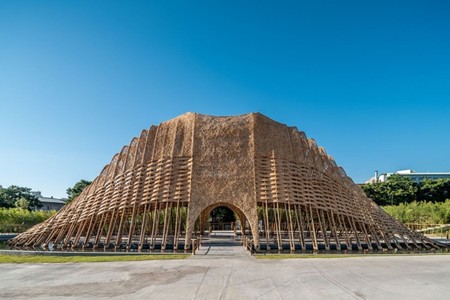
The group stands proudly at the entrance of the soaring bamboo pavilion. This structure itself is a lesson—showing that sustainable materials can create breathtaking, modern forms.

Our field trip for the Architecture Study Program was originally scheduled for December 1, 2025. But nature had other plans. The catastrophic floods of late November – the same system failure I spoke about in my recent seminar – forced us to pause.

Today, December 22, we finally made the journey. And perhaps it was fitting. We went to learn about nature and bamboo construction exactly when the memory of nature’s power was freshest in our minds.

Alhamdulillah. Despite the obstacles, despite the rescheduling, despite the logistics, we are here. I came as the only lecturer, but I knew I wasn’t bringing them alone. The real expertise today would come from those who live and work with these principles daily.

Walking through the lush landscape of Orangutan Haven. For architecture students used to studio screens, this immersion in nature is a vital reset and inspiration.

Seeing the students out here, breathing fresh air instead of studio dust, I am reminded why we do this. Architecture is not learned solely in front of a screen. It is learned by touching the earth, feeling the material, and understanding the context we build in.

The Residents of The Haven

Orangutan Haven isn’t a zoo. It’s a sanctuary for those who cannot go back.

We started with a hike. The green landscape was a relief for eyes tired of concrete and screens. The team at Orangutan Haven guided us gently up the trail, pointing out plants, explaining the ecosystem. These aren’t park rangers following scripts – they are conservationists with deep knowledge and genuine passion.

The open-air amphitheater provides a space for reflection. Surrounded by the sounds of the forest, students process the stories of displacement and resilience they’ve just heard.

Sitting in the amphitheater, students listen to the tragic but important histories of residents like Leuser and Lewis. A sobering reminder of why we must design responsibly.

But the real lesson began when we sat down to hear the stories of the residents here.

Deknong. Fajrin. Lewis. Leuser. Dina. etc.

These aren’t just names; they are tragedies caused by human design – or lack of it.

The Orangutan Haven team explained each story with both scientific precision and emotional honesty. Leuser, blind because he was shot 62 times with an air rifle. Dina, paralyzed from illness as a baby. Lewis, blinded by shots from farmers protecting plantations.

They cannot be released into the wild. Because of us. Because our development patterns, our plantations, our encroachment left them no space.

I watched the students as they listened. The “fun” field trip vibe shifted to something deeper. You could see them processing it: *We are studying to be builders. Our designs will eat up land. Are we going to be part of the problem, or part of the solution?*

That moment – that pause – was worth the entire semester of theory. Because empathy is the foundation of sustainable design. You cannot design for nature if you do not feel for it.

And the Orangutan Haven team facilitated this perfectly. They didn’t preach. They just told the truth, and let the students feel it.

The Bamboo Workshop – From River To Structure

The second session shifted from “why” to “how.”

And here, the Orangutan Haven team truly shone. These are practitioners who work with bamboo daily – not as theory, but as lived practice. Having them teach our students was invaluable. It bridges the gap between my academic instruction and real-world sustainable construction.

Under the shade of bamboo groves, the Orangutan Haven team shares their deep knowledge of the ecosystem. Today, the forest is our lecture hall.

Students and Orangutan Haven team members gathered by the river—a perfect example of sustainable structure in harmony with nature.

We talk a lot about sustainability in class. But today, the students got their hands dirty with it. The bamboo workshop wasn’t just about tying knots; it was a full lifecycle lesson, taught by people who actually build with bamboo.

The team walked students through every step:

Selection: Not every bamboo is ready to build. They explained how to identify the right age, the right species. Betung (Dendrocalamus asper) for structural elements. Tali (Gigantochloa apus) for bindings and smaller components. They showed how to read the color, feel the density, assess readiness.

The bamboo workshop in full swing. Surrounded by the raw material, students listen intently as the Orangutan Haven team explains the nuances of selecting and preparing bamboo for construction.

Harvesting: There’s a right way to cut so the clump regenerates. Cut too young, you weaken the material. Cut too old, it’s brittle. Cut wrong, you kill the clump. The team demonstrated the traditional technique passed down through generations, but explained the science behind why it works.

Cleaning: Students helped strip branches, then took the culms to the river. The team explained why river washing matters – it’s not just removing dirt, it’s removing surface fungi and sap that would otherwise attract beetles and decay. Watching students in the river, laughing as they scrubbed bamboo, was pure joy.

From cleaning in the river to crafting joinery, today they didn’t just study sustainable materials—they built with them.

Preservation: This was the critical technical lesson, and the team was meticulous. How to pierce the nodes (membolongkan ruas) so the borax-boric acid solution can penetrate the entire culm. They explained the chemistry simply: borax prevents fungal growth, boric acid prevents insect infestation. Without this, bamboo lasts 3-5 years. With this, it can last 30+ years.

They demonstrated the technique, then supervised as students practiced. Patient corrections. Encouragement. This is teaching at its best – expert practitioners sharing knowledge generously.

Crafting: Then came the creative challenge. Students were asked to design and build signage using bamboo. The Orangutan Haven team provided tools, materials, and guidance – but let students figure out the problems themselves.

I saw frustration. “Why won’t this stay together?”

I saw problem-solving. “If we angle it this way…”

I saw collaboration. “Hold this while I cut this…”

And then I saw pride when their signage actually stood up.

The team celebrated each successful structure. Not patronizing praise, but genuine appreciation. “You did well. This bamboo cut will doing great.”

Pausing near the bamboo bridge. It’s not just a crossing; it’s a testament to engineering with natural materials—strong, flexible, and beautiful.


This field trip was about more than orangutans and bamboo. It was about “inception” – planting ideas that will grow over time.


When students return to studio, they will design buildings. Some will become architects choosing materials for hotels, schools, houses. Most will default to what they know: concrete, steel, glass.

But maybe – just maybe – today planted a seed.

Maybe when they’re specifying materials five years from now, they’ll remember the feel of bamboo in their hands. The weight of it. The way it split when they cut wrong, but held strong when they did it right.

Maybe they’ll remember Leuser’s sightless eyes and think twice about building on forested land.

Maybe they’ll remember how patient the Orangutan Haven team was – how these experts shared knowledge not to show off, but because they genuinely wanted the next generation to do better.

This is why I took them there. Not for fun (though we had that). Not for grades (though they’ll write reflections). But for this: to shift how they think about what it means to build.

Architecture education happens in many places. Lecture halls teach theory. Studios teach design process. But places like Orangutan Haven – with practitioners like this team – teach something deeper. They teach values.

And values shape every design decision for a lifetime.

As we loaded back onto the bus, exhausted and muddy, I felt grateful.

Grateful that despite floods and delays, this happened.

Grateful for the Orangutan Haven team, who shared their expertise so generously. They didn’t have to do this. They could have given us a standard tour. Instead, they gave students a transformative experience.

Grateful for students who showed up ready to learn. Who listened to tragic stories without cynicism. Who wrestled with bamboo without giving up. Who asked good questions.

And grateful for the reminder – which I needed as much as they did – that we are not separate from nature. We are part of it. Our buildings are part of it. Our design decisions affect it.

When Cyclone Senyar flooded Medan three weeks ago, it was because we forgot this. We designed as if water was an obstacle to eliminate, rather than a system to work with.

When orangutans lose their habitat, it’s because we designed plantations and cities as if forests were empty space waiting to be claimed.

But it doesn’t have to be this way.

We can design differently. With the land. With the rivers. With the forests. With the orangutans.

That’s the future I want my students to build.

And today, thanks to the Orangutan Haven team and the lessons they taught, I think we took one small step toward that future.

To my students: I hope you enjoyed the hike. I hope you had fun in the river. I hope you’re proud of the signage you built.

But mostly, I hope you remember this day when you’re making real decisions about real projects. When a client says “just use concrete,” remember bamboo. When a developer wants to clear forest, remember Leuser. When you’re tired and tempted to design the easy way, remember the Orangutan Haven team’s patience and passion.

To the Orangutan Haven team: Thank you. You taught my students things I cannot teach in a classroom. You showed them what it looks like to live your values. You gave them a gift.

Alhamdulillah for a safe journey. Alhamdulillah for good teachers. Alhamdulillah for students willing to learn.

Now, back to the studio. We have a lot of work to do.

But we’re going to do it a little differently now.

Beyond Green: Why Bamboo Needs Computational Optimization

Exploring How Computational Design Can Transform Bamboo Architecture in Indonesia

As I prepare to embark on doctoral research in computational design and sustainable architecture, I find myself constantly returning to a material that has defined my Indonesian homeland for centuries: bamboo. Walk through any village in Sumatra, Java, or Bali, and you’ll see it everywhere – used for homes, bridges, furniture, and art. Indonesia is home to 176 documented bamboo species, with 105 being endemic, making us a global biodiversity hotspot for this remarkable material [1]. Yet despite this abundance and our deep cultural connection, I believe we’ve been asking the wrong question about bamboo in architecture.

For years, the conversation has centered on a simple narrative: “Is bamboo sustainable?” The answer, definitively, is yes. A single hectare of bamboo sequesters approximately 17 tonnes of carbon annually – significantly more than most tree species [2]. Its rapid renewability, with harvesting cycles of just 3-5 years compared to decades for timber, positions it as one of the most regenerative building materials available [3]. These facts are powerful and important.

But here’s the critical insight I want to explore in this post: sustainability without performance is a missed opportunity. The simple act of substituting bamboo for traditional materials without fundamentally changing our design process is, in many ways, like driving a Ferrari in first gear. We’re not utilizing its full potential.

The architectural potential of bamboo is immense, but realizing it requires moving beyond traditional design methods.

As a lecturer teaching architecture students at Universitas Medan Area, I see this challenge firsthand. My students are eager to use bamboo – it aligns with their values, it’s locally abundant, it’s culturally meaningful. But when they sit down to design a structure, they often fall back on conventional design methods: static calculations, safety factors borrowed from timber design, and joinery details that don’t account for bamboo’s unique properties. The result? Over-designed, materially inefficient structures that don’t realize bamboo’s true promise.

This is where computational optimization enters the picture, and why I believe it’s essential for the future of Indonesian architecture.

In this post, I’m not declaring universal truths – I’m exploring why I believe computational design is crucial for unlocking bamboo’s performance potential. These are questions I’m actively investigating as I prepare for PhD study, and I’d love your perspective.

The Anisotropic Challenge: Why Bamboo is Not Wood

One of the first things I realized in my research is that a fundamental mistake undermines much bamboo design: treating bamboo as a simple wooden pole. This assumption is dangerous because it’s partially true, which makes it deceptively misleading.

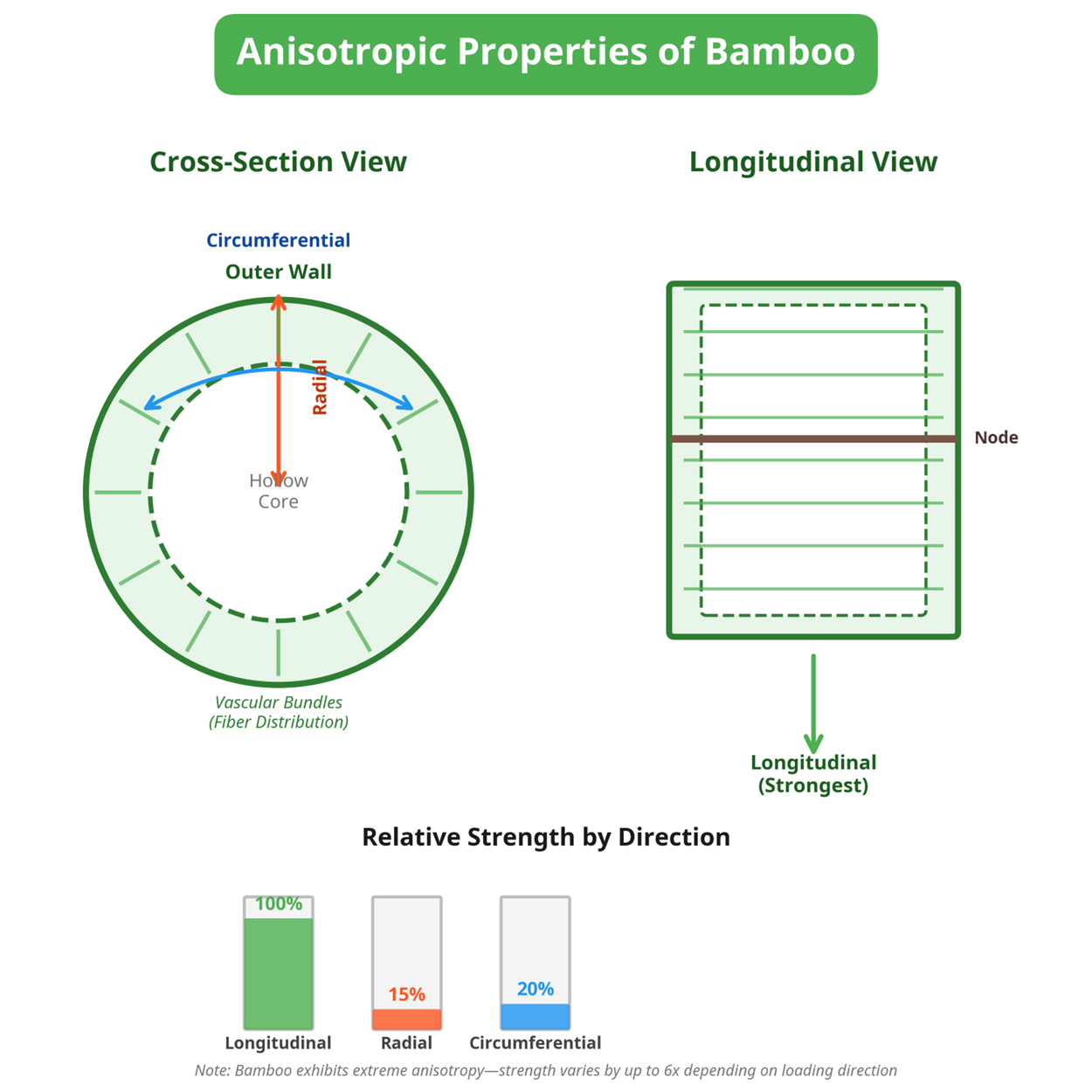
Bamboo is a functionally graded, anisotropic composite material – meaning its mechanical properties vary directionally and change systematically from the inner to outer culm wall [4]. To understand what this means in practice:

Along the fibers (longitudinal direction): Bamboo’s tensile strength rivals mild steel—up to 140-160 MPa for species like Dendrocalamus asper (betung) and Gigantochloa apus (ampel), the two most common species in Indonesia [5].

Perpendicular to fibers (radial/circumferential directions): Strength drops dramatically – up to 6 times weaker in some directions [4].

This difference in strength stems from bamboo’s elegant biomechanical structure: cellulose fibers are primarily oriented along the culm’s length, embedded in a lignin matrix. Additionally, the density and diameter of vascular bundles vary from the inner to outer wall, creating a natural gradient that’s been optimized by millions of years of evolution to resist wind and bending loads [6].

The anisotropic nature of bamboo, showing its primary strength along the longitudinal axis versus its weaker properties in the radial and circumferential directions. Strength can vary by up to 6x depending on loading direction.

Why conventional design fails:

Traditional architectural and engineering design methods rely on isotropic assumptions – the assumption that a material has uniform properties in all directions. This works reasonably well for steel or concrete, where isotropy is engineered into the manufacturing process. But for bamboo, this assumption is fundamentally violated.

This leads to two critical problems in practice:

  1. Material Inefficiency: Engineers, uncertain about bamboo’s directional weaknesses, often over-design structures with excessive safety factors [7]. I’ve seen bamboo frames using far more culms and material than structurally necessary. This negates some of bamboo’s sustainability advantage—if you use 50% more material than needed, your carbon payback period extends dramatically [7].
  2. Unpredictable Failure: An incomplete understanding of directional weaknesses can lead to catastrophic, unexpected failures. The most common failure mode I’ve observed in bamboo structures is longitudinal splitting—the culm fractures along its length. This typically occurs when loading direction isn’t optimized for fiber orientation or when designers use joinery details designed for isotropic materials [7].

How computational design changes this:

Finite element modeling allows architects to build detailed computational models that explicitly define bamboo’s anisotropic properties. Rather than applying uniform assumptions, the model understands that stress flows differently through the material depending on direction.

Engineers can then simulate:

  • How stress distributes through actual bamboo geometry with real anisotropic properties
  • Where maximum stresses occur and in which directions
  • Which culm orientations best resist applied loads
  • Optimal joint designs for actual bamboo behavior (not theoretical isotropy)

The result: structures that use bamboo efficiently, in its strongest orientations, with material placed exactly where it’s needed. This is performance-driven design, not assumption-driven design.

Indonesian context matters: In my teaching, I’m increasingly using parametric models showing students how Dendrocalamus asper (popular in North Sumatra) behaves differently than Gigantochloa apus (common in Bali) due to their different fiber orientation patterns and wall thickness gradients [5]. This localized knowledge becomes powerful when encoded computationally.

The Moisture Problem: Designing for a Living, Breathing Material

Beyond structural anisotropy lies another profound challenge: bamboo is hygroscopic – it constantly absorbs and releases moisture in response to atmospheric humidity. In Indonesia’s tropical climate, this isn’t a minor detail. It’s perhaps the critical factor determining long-term structural performance [8].

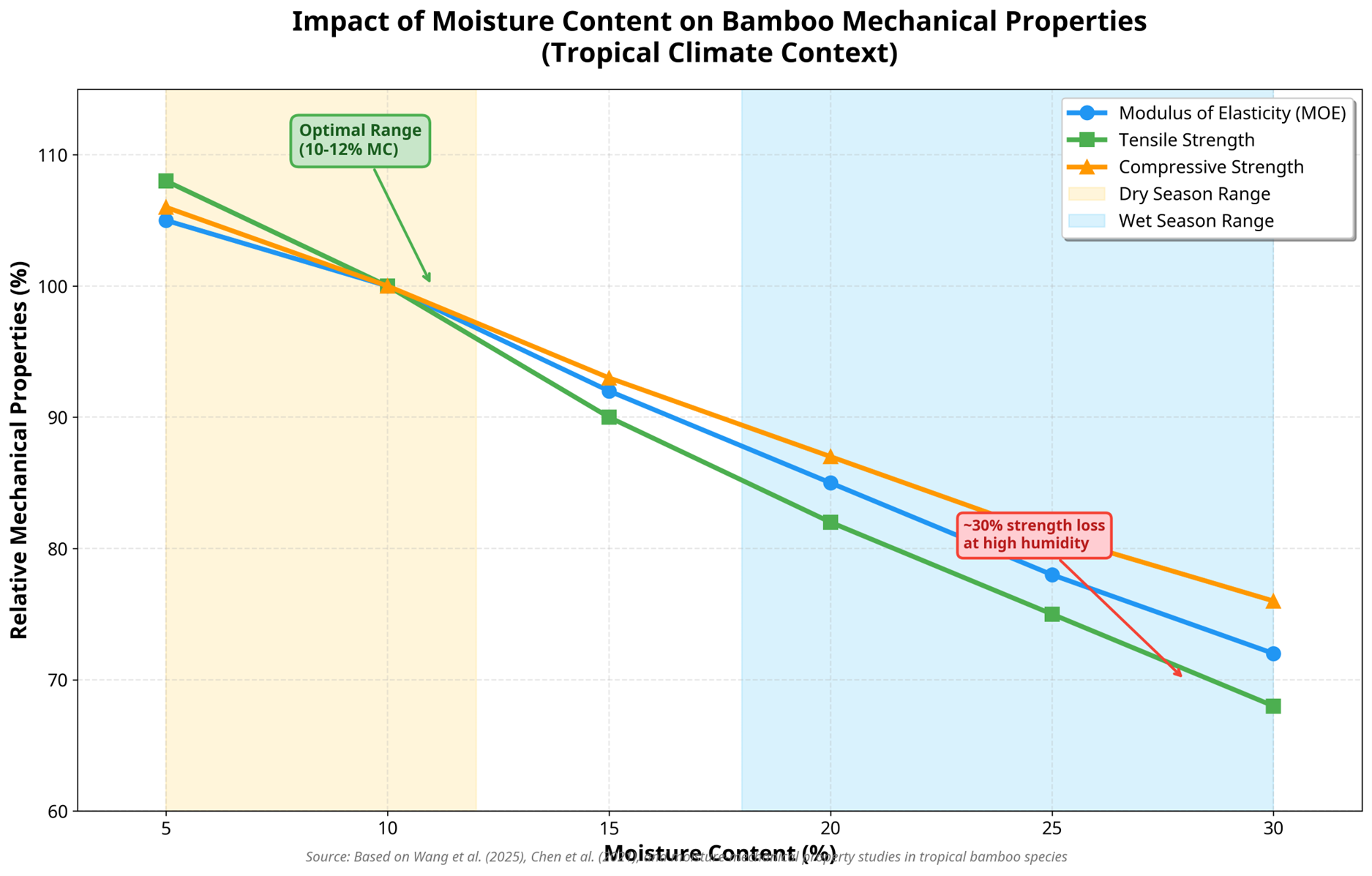
Here’s what happens: As moisture content increases, bamboo’s mechanical properties systematically degrade.

Studies show that [8] [9]:

  • Tensile strength decreases by up to 40-50% as moisture content increases from dry to saturated condition [9]
  • Elastic modulus (stiffness) decreases significantly, meaning the material becomes more flexible [8]
  • Dimensional stability changes: The material swells and shrinks, with different swelling rates in different directions [8]

In tropical Indonesia, seasonal moisture variations are extreme. During the rainy season (November-March), relative humidity can reach 95% or higher, causing bamboo moisture content to rise dramatically. During the dry season (June-September), humidity drops to 60-70%, and bamboo moisture content decreases. This cycle repeats year after year.

The practical problem:

Imagine a bamboo joint designed in controlled conditions—perhaps a laboratory in Stuttgart or Singapore where humidity is relatively stable. The joint is tight, load-bearing connections are perfect. Now place that same joint in a rural Sumatran village experiencing tropical humidity cycles:

  • Wet season: Bamboo swells; the joint tightens or becomes overstressed
  • Dry season: Bamboo shrinks; the joint loosens, potentially compromising structural integrity

The inverse relationship between moisture content in bamboo and its key mechanical properties. In tropical climates, seasonal humidity variations can cause up to 30% strength loss.

A joint tight during dry season becomes loose in wet season. A connection designed for static conditions becomes dynamic and unpredictable. This is why traditional Indonesian bamboo buildings employ specific joinery techniques that accommodate movement—our ancestors understood this intimately, even if they described it differently [10].

How conventional design fails:

Static design methods assume material properties remain constant throughout the building’s lifetime. Bamboo design guidelines often cite material properties at “standard” moisture content (around 12%), but never address the reality that Indonesian buildings experience moisture contents ranging from 8% to 20% or higher depending on season and location.

How computational optimization changes this:

Environmental-responsive parametric design incorporates real climate data directly into structural models [11]. Rather than assuming static moisture content, the design process:

  1. Integrates historical climate data from the specific building location
  2. Models moisture content cycles throughout the year based on humidity patterns
  3. Simulates structural behavior across the full range of moisture conditions
  4. Designs joints and connections that remain structurally sound whether bamboo is at its driest or wettest seasonal state
  5. Predicts movement and designs the structure to accommodate it

This level of analysis is impossible through manual calculations – the variables are too many, the relationships too complex. But computational models can simulate years of seasonal cycling in minutes, predicting how a structure will perform over decades [11].

Indonesian example I’m exploring: For buildings in Medan where I teach, tropical climate data shows humidity averages 75-80% year-round with minimal seasonal variation compared to other regions. This means different optimal designs than, say, a building in Bali where seasonality is more pronounced. Computational design makes this regional differentiation explicit and testable.

Encoding traditional wisdom: Interestingly, traditional Indonesian bamboo joinery often uses sliding connections or slightly loose joints that can accommodate movement. This isn’t haphazard – it’s sophisticated engineering [10]. Computational design can formalize this traditional knowledge, testing whether specific joint geometries actually optimally accommodate seasonal moisture cycling, and potentially improving on them.

From Variability to Opportunity: Embracing Natural Irregularity

Here’s where my research takes an exciting turn. In industrial construction, standardization is sacred. Materials are mass-produced to uniform specifications. A steel I-beam ordered in Jakarta is identical to one in Bandung. This standardization enables reproducibility and simplifies design calculations.

Bamboo, as a natural material, fundamentally resists this logic. Each culm is unique:

  • Diameter variations (within a single species, culms can vary from 4cm to 12cm)
  • Wall thickness variations (outer and inner wall diameter ratios vary)
  • Internode spacing variations (distance between nodes isn’t uniform)
  • Fiber orientation variations (subtle differences in how fibers are arranged)

For decades—honestly, for centuries until very recently—this variability was seen as a defect. Something to overcome through processing. Indonesian and other tropical builders dealt with this variability through:

  • Careful selection: Master craftspeople would age bamboo, split it lengthwise to examine fiber direction, and manually select pieces for specific structural roles
  • Lamination: Processing bamboo into laminated lumber to create artificial uniformity
  • Over-design: Using thicker sections and more material to account for uncertain properties

These approaches work, but they’re labour-intensive, require deep expertise, and often negate bamboo’s material and economic efficiency.

The computational perspective flips this entirely:

What if variability isn’t a problem to overcome, but data to harness?

3D scanning and digital inventorying technologies can capture the precise geometric and material properties of every single culm available for a project. Feed this data into an optimization algorithm, and you get something remarkable: a system that functions like a master craftsperson with perfect information—selecting the ideal bamboo piece for each specific structural role [12].

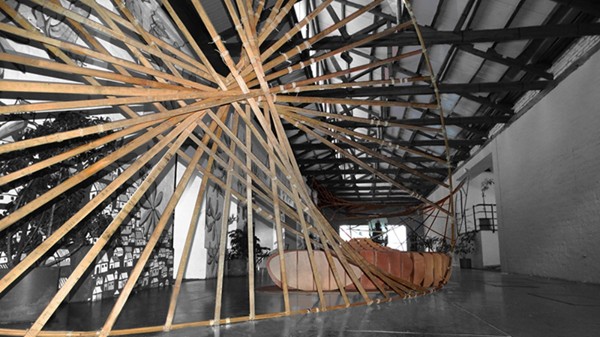
3D scanning technologies can capture the unique geometric properties of each bamboo culm, turning natural variability into precise data for computational design.

Here’s how it works in practice:

  1. Scanning & Data Capture: Each bamboo culm is 3D-scanned to capture outer diameter, wall thickness variations, internal node geometry, and fiber orientation [12]
  2. Material Testing: A sample of culms are tested to establish property relationships (e.g., how wall thickness correlates to strength for this species)
  3. Algorithmic Selection: An optimization algorithm uses this data to assign each culm to specific positions in the structure where its unique properties are best utilized
  4. Structural Performance: The strongest, stiffest culms go where maximum load is concentrated; more flexible culms work in regions of lower stress; slender culms are used decoratively where they’re not load-critical
  5. Economic Benefit: The structure uses less material overall while maintaining or exceeding performance requirements

This process is called topology optimization or material-aware design, and it’s moving from theoretical research into semi-automated fabrication reality. Research at ETH Zurich’s Digital Building Technologies lab and ITKE at University of Stuttgart has demonstrated this working at architectural scales [14, 15].

ITKE’s computational bamboo research demonstrates how algorithmic design can work with natural material variability to create structurally optimized forms.

What excites me most: This approach celebrates bamboo’s natural diversity rather than fighting it. It’s the opposite of industrial homogenization. Each bamboo structure becomes uniquely optimized to its specific available materials, its specific climate, its specific structural requirements. And paradoxically, this variation-embracing approach leads to better performance and lower environmental impact than trying to force all bamboo into standardized categories.

Indonesian opportunity: With 176 bamboo species [1], many with subtle property variations, Indonesia has an extraordinary opportunity to lead in material-aware computational design. Rather than standardizing all bamboo, we could develop species-specific design protocols that account for the unique properties of Dendrocalamus asper vs. Gigantochloa apus vs. endemic species found only in specific regions.

Multi-Objective Optimization: Beyond Structure into Culture

Here’s where I believe computational design becomes genuinely powerful for Indonesian architecture: optimizing for multiple competing objectives simultaneously.

A successful building is never just about structural performance. It must simultaneously achieve:

  • Structural safety (won’t collapse)
  • Economic viability (cost-effective)
  • Environmental responsibility (low carbon, sustainable materials)
  • Constructability (can actually be built with available skill and equipment)
  • Cultural authenticity (resonates with place and people)
  • Aesthetic integrity (visually appropriate and beautiful)

In Indonesia particularly, the last criterion – cultural resonance – is irreplaceable. A structurally perfect design that’s culturally alien is ultimately a failure. It won’t be maintained, won’t be valued, won’t inspire future practitioners.

Traditional design methods can technically “optimize” for one criterion (usually lowest cost or maximum span). But the moment you introduce multiple competing objectives, manual design becomes unwieldy. How do you simultaneously minimize cost, maximize cultural appropriateness, and optimize structural efficiency? How do you make informed trade-offs?

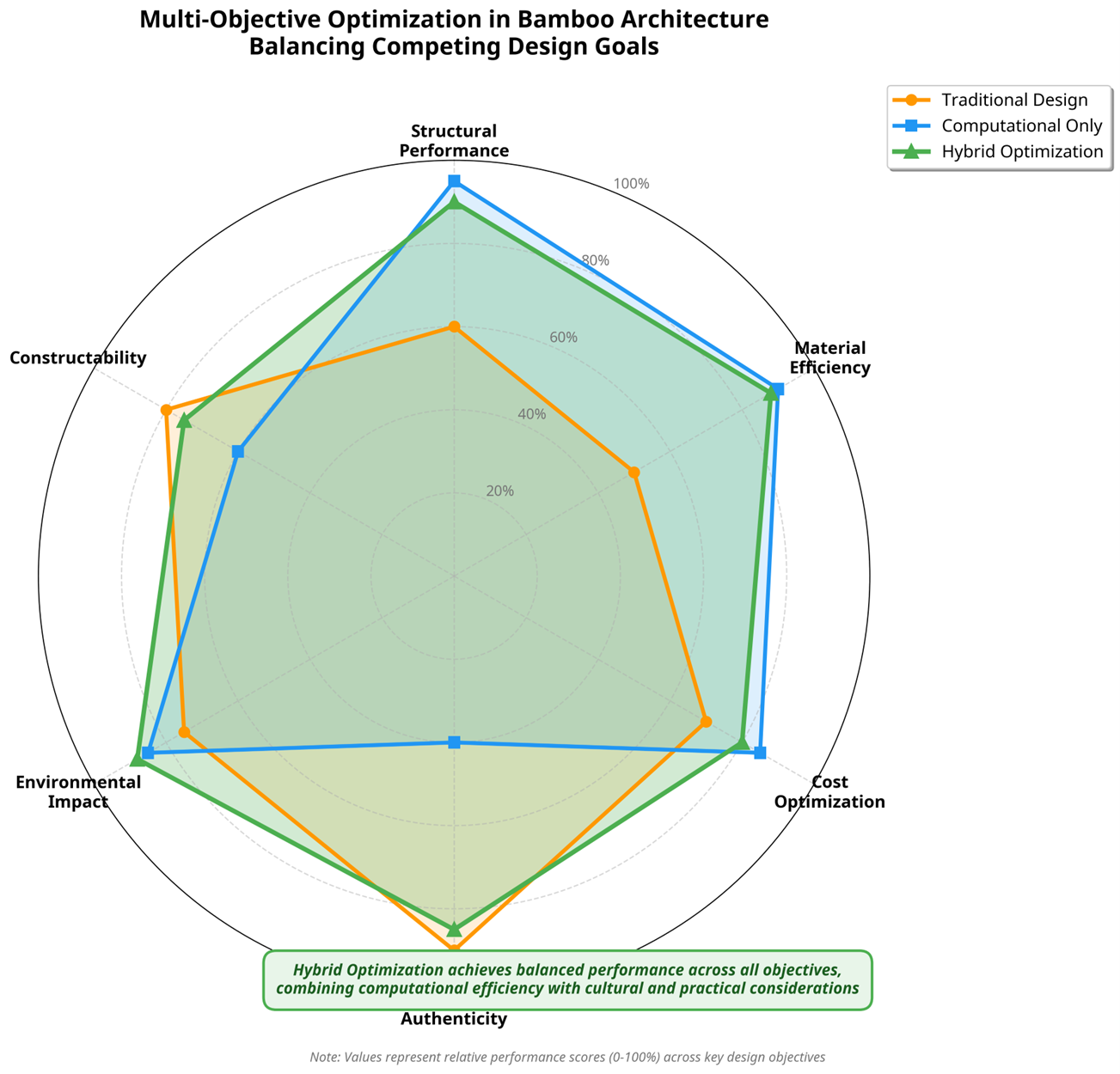
Multi-objective optimization balances competing goals such as structural performance, cost, sustainability, and cultural aesthetics. Hybrid computational approaches achieve the best overall balance.

Multi-objective optimization algorithms solve this elegantly:

These algorithms allow designers to define:

  1. Quantifiable performance objectives (minimize material use, minimize cost, minimize carbon, maximize structural efficiency)
  2. Design constraints (must accommodate traditional joinery, must use available bamboo species, must fit within site constraints)
  3. Relative importance weights (cost is important, but cultural appropriateness is more important)

The algorithm then generates a Pareto front—a set of optimal solutions representing the best possible trade-offs between competing objectives. Rather than a single “best” solution, the designer gets multiple solutions, each optimal for slightly different priority weightings.

In practice, for an Indonesian bamboo school project, this might mean:

The algorithm explores designs that:

  • Minimize material use (environmental objective) [11]
  • Use only local Indonesian bamboo species (cultural/economic objective)
  • Employ traditional joinery techniques from Bali/Java/Sumatra (cultural objective) [10]
  • Meet modern building code requirements (safety objective)
  • Fit within a specific budget (economic objective)
  • Can be fabricated by local craftspeople without importing specialized equipment (social/economic objective)

Rather than compromising across all these goals mediocrely, the algorithm finds designs that excel at different trade-off combinations. The architect then selects which combination best serves the specific project context.

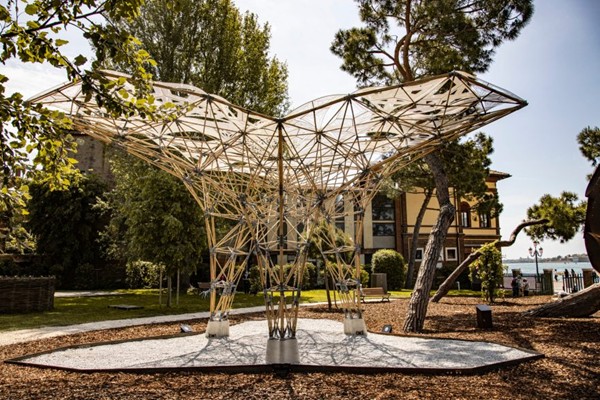
ETH Zurich’s Digital Bamboo project showcases integrated computational workflows that combine structural optimization with fabrication constraints.

Why this matters for Indonesia:

This approach allows computational design to be culturally intelligent. It’s not imposing a globally-standard design methodology; it’s enabling architects to encode Indonesian design values – cultural continuity, local material sourcing, traditional craft techniques – directly into the optimization framework. The result is high-performance architecture that’s computationally rigorous AND culturally rooted.

I see this as essential for sustainable practice in Indonesia. We don’t want our buildings to look like they could have been designed anywhere—we want computational efficiency in service of deepening our architectural identity, not erasing it.

Moving Forward: Computational Design as Indonesia’s Opportunity

As I prepare to pursue doctoral research in this intersection of computational optimization and bamboo architecture, I’m increasingly convinced this isn’t a luxury – it’s a necessity for Indonesia.

Consider our situation: We have the most biodiverse bamboo resource globally – 176 species [1], enormous cultivation potential, centuries of craft knowledge [10]. We have urgent needs: housing shortages, infrastructure gaps, climate commitments. We have emerging capability: young architects and researchers trained in computational design, growing access to digital fabrication tools, universities engaged in this research space.

What we’re building is the computational capacity to leverage all of this simultaneously – our material abundance, our cultural knowledge, our urgent development needs, our technical capability.

But I’ll be honest: the challenges are real. The barriers include:

  • Limited computational design expertise in most Indonesian architecture schools
  • Need for comprehensive material property databases specific to Indonesian bamboo species [5]
  • Integration challenges between traditional craft knowledge and digital workflows
  • Affordable access to design software and computational resources
  • Convincing construction industry to adopt new methods

And yet, the potential payoff is immense:

  1. Indonesian intellectual leadership: Positioning Indonesia as a global research center in sustainable computational architecture, not just a bamboo supplier
  2. Scalable housing solutions: Moving from one-off artisanal bamboo buildings to productized, computationally-optimized bamboo housing that meets massive development needs
  3. Cultural continuity through innovation: Preserving and evolving traditional knowledge rather than watching it disappear as younger generations move toward reinforced concrete
  4. Climate contribution: Actually achieving the carbon benefits of bamboo [2] through efficient design, not just using it as a “green” substitute

This is the work I’m committing the next several years to. I’ll be documenting this journey on this blog – sharing insights, dead-ends, breakthroughs, and questions as I navigate PhD applications and eventually doctoral research. I’m not claiming certainty or declaring universal principles. I’m exploring. I’m curious. I’m working through these questions systematically.

If you’re an Indonesian architect, student, researcher, or practitioner interested in this space, I’d genuinely love to hear from you. What are your observations about bamboo design in practice? What barriers do you see? What excites you about computational approaches? Let’s work through this together – this is too important and too complex for any individual to solve alone.

References

[1] Ekawati, L. Karlinasari, R. Soekmadi, and I. Nurrochmat, “The status of bamboo research and development for sustainable use in Indonesia: A systematic literature review,” IOP Conference Series: Earth and Environmental Science, vol. 1109, no. 1, p. 012100, 2022.

[2] “Bamboo plants can act as efficient carbon sinks,” Nature India, Mar. 30, 2021. [Online]. Available: https://www.nature.com/articles/nindia.2021.46

[3] O. S. B. V., “Top 5 Bamboo material environmental benefits,” MOSO Bamboo Blog. [Online]. Available: https://blog.moso-bamboo.com/top-5-bamboo-material-environmental-benefits

[4] Akinbade, L. Horne, J. Nash, J. Heeley, and T. Morsink, “Modelling full-culm bamboo as a naturally varying functionally graded material,” Construction and Building Materials, vol. 310, p. 125211, 2021.

[5] Hartono et al., “Physical, chemical, and mechanical properties of six bamboo from Sumatera Island Indonesia and its potential applications for composite materials,” Polymers, vol. 14, no. 22, p. 4868, Nov. 2022.

[6] Sun et al., “Bionic design and multi-objective optimization for variable wall thickness tube inspired bamboo structures,” Thin-Walled Structures, vol. 113, pp. 114-123, 2017.

[7] Triwiyono et al., “Optimizing Bamboo as an Alternative Building Material to Respond Global Architectural Challenges,” IOP Conference Series: Earth and Environmental Science, vol. 1157, no. 1, p. 012011, 2023.

[8] Chen et al., “Water vapor sorption behavior of bamboo pertaining to its structure,” Scientific Reports, vol. 11, no. 1, p. 12543, 2021.

[9] Wang et al., “Correlations between moisture expansion and flexural properties of bamboo strips under different loading rates,” Holzforschung, vol. 78, no. 8, pp. 715-724, 2024.

[10] Huda et al., “Bamboo architecture as a learning project for community development of rural area in Indonesia,” IOP Conference Series: Earth and Environmental Science, vol. 490, no. 1, p. 012004, 2020.

[11] Tedjosaputro et al., “Multi-objective optimisation of bamboo tensegrity structure for immediate relief shelters,” City, Territory and Architecture, vol. 12, no. 1, p. 14, 2025.

[12] Saghafi Moghaddam et al., “Bamboo spatial structure, developing an integrated computational workflow and a tailored semi-automated fabrication apparatus,” International Journal of Architectural Computing, vol. 22, no. 4, pp. 567-585, 2024.

[13] Columbia GSAPP, “Structural Optimization of Composite Bamboo Beams,” May 28, 2024. [Online]. Available: https://www.arch.columbia.edu/student-work/12707-structural-optimization-of-composite-bamboo-beams

[14] Digital Building Technologies, ETH Zurich, “Digital Bamboo,” Oct. 8, 2020. [Online]. Available: https://dbt.arch.ethz.ch/project/digital-bamboo/

[15] ITKE, University of Stuttgart, “Computational Bamboo,” 2017. [Online]. Available: https://www.itke.uni-stuttgart.de/

The Bamboo Renaissance: Indonesia’s Role in Global Climate Architecture

Standing at the forefront of our planet’s climate crisis, the global architecture community faces an unprecedented challenge: how to build the structures our growing population desperately needs while dramatically reducing the carbon footprint of construction. In this pivotal moment, an ancient grass from the tropical forests of Southeast Asia has emerged as perhaps our most promising ally. Bamboo—once dismissed in many parts of the world as the ‘poor man’s timber’—is experiencing a remarkable renaissance, and Indonesia stands at the epicenter of this transformation. From the innovative bamboo pavilions that have captivated international architectural publications to the scientific breakthroughs emerging from Indonesian research institutions, the archipelago is not merely participating in the global shift toward sustainable construction; it is leading it.

The urgency of this transformation cannot be overstated. The construction industry remains one of the world’s most carbon-intensive sectors, responsible for approximately 39% of global carbon emissions when we include both operational and embodied carbon [1]. The production of cement alone accounts for 8% of global CO₂ emissions, while steel production adds another significant burden to our atmospheric carbon load [2]. As the global population continues to urbanize—with the World Bank forecasting a 150% increase in urban populations by 2045—the demand for housing and infrastructure will only intensify [3]. Traditional building materials simply cannot meet this demand without catastrophic environmental consequences. This is where Indonesia’s bamboo expertise becomes not just valuable but essential for our planet’s future.

Indonesia’s Bamboo Supremacy: A Natural and Cultural Foundation

Indonesia’s position as a global bamboo powerhouse extends far beyond mere abundance. The archipelago hosts an extraordinary 176 documented bamboo species, with 105 being endemic—meaning they exist nowhere else on Earth [4]. This biological treasure trove represents one of the world’s most diverse collections of bamboo genetics, each species offering unique properties that can be optimized for specific architectural applications. From the massive Dendrocalamus asper (Giant Bamboo) that can reach diameters exceeding 20 centimeters and heights of 30 meters to the more delicate varieties perfect for intricate architectural details, Indonesia’s forests contain a living library of sustainable building materials.

But Indonesia’s bamboo renaissance is not solely about natural resources—it represents a profound cultural continuity that bridges ancient wisdom with contemporary innovation. For centuries, Indonesian communities have developed sophisticated traditional building techniques that maximize bamboo’s unique properties. The traditional Karo Batak houses of North Sumatra, constructed entirely from bamboo and wood using no nails or screws but held together with natural fibers, demonstrate engineering principles that modern architects are only beginning to fully appreciate [5]. These structures have withstood tropical storms, earthquakes, and the test of time, proving that bamboo construction can be both durable and beautiful when properly executed.

Recent scientific research has validated what traditional builders knew intuitively. Studies examining six bamboo species from Sumatra Island revealed that Betung bamboo (Dendrocalamus asper) demonstrates the highest structural performance values, making it particularly suitable for load-bearing applications [6]. This scientific backing provides the foundation for modern engineering standards while honoring centuries of accumulated knowledge. The integration of traditional Indonesian craftsmanship with contemporary design principles has created a unique architectural language that is distinctly Indonesian yet universally applicable.

The Global Influence: How Bali’s Bamboo Pioneers Changed the World

The transformation of bamboo from a vernacular building material to an internationally acclaimed architectural medium can be traced to a handful of visionary projects in Bali that captured global attention. The Green School Bali, established in 2008, serves as perhaps the most influential demonstration of bamboo’s potential in contemporary architecture. This tropical jungle campus of curved bamboo pavilions has become a globally influential exhibition of sustainable design, inspiring architects worldwide to reconsider their material choices [7].

The school’s impact extends far beyond its physical structures. Recognized by the World Economic Forum as a progressive ‘school of the future,’ Green School Bali has demonstrated that bamboo buildings can be sophisticated, durable, and environmentally responsible [8]. The campus generates over 150 kilograms of fresh produce monthly, operates vehicles powered by cooking oil, and achieves a 40% reduction in carbon footprint compared to conventional schools [9]. These achievements prove that bamboo architecture is not about making do with less, but about achieving more with materials that actively benefit the environment.

Building on the Green School’s foundation, Elora Hardy’s IBUKU design firm has pushed bamboo architecture into new territory, creating structures that redefine luxury while maintaining environmental responsibility. Since 2010, IBUKU has completed over 60 bamboo structures throughout Bali and the region, ranging from private residences to commercial developments [10]. Their projects, including the iconic Arc at Green School—the world’s largest bamboo arched structure—and the six-story Sharma Springs residence, have appeared in international publications including Architectural Digest, Vogue, and Architectural Review [11].

What makes IBUKU’s work particularly significant is its influence on global architectural practice. The firm’s design vocabulary, based on working with bamboo’s natural curves and inherent properties rather than imposing geometric constraints, has inspired architects worldwide to reconsider their relationship with materials. Projects by IBUKU and other Indonesian bamboo architects have influenced firms in Vietnam, Thailand, China, and even Europe, creating a ripple effect that is transforming sustainable architecture globally [12].

Climate Champion: The Science Behind Bamboo’s Environmental Impact

The environmental case for bamboo in construction is compelling and backed by increasingly sophisticated scientific research. Unlike conventional building materials that are carbon-positive in their production, bamboo is fundamentally carbon-negative throughout its lifecycle. During its rapid growth phase, bamboo sequesters approximately 17 tons of carbon per hectare annually—significantly more than most tree species [13]. Some studies suggest that well-managed bamboo forests can sequester up to 50 tons of CO₂ per hectare annually, making them among the most effective carbon sinks available [14].

The carbon benefits extend beyond sequestration during growth. Recent life-cycle analyses indicate that bamboo products can mitigate between 1.38 and 2.29 gigatons of CO₂ equivalent by 2050, primarily through substitution of carbon-intensive materials like steel and concrete [15]. This mitigation potential is particularly significant because it addresses both embodied carbon (the emissions associated with material production) and the ongoing carbon storage within the built structure itself.

The United Nations Framework Convention on Climate Change has recognized this potential through its BambooBoost Initiative, which estimates that applying bamboo cultivation to 70-174 million hectares of degraded forestlands could sequester roughly 2 gigatons of CO₂ annually—equivalent to 7.7% of current global emissions [16]. Indonesia is in a unique position to significantly contribute to these global climate goals due to its vast areas of degraded land and ideal growing conditions.

Beyond carbon considerations, bamboo offers multiple environmental benefits that support broader sustainability objectives. The plant’s extensive root system prevents soil erosion, particularly valuable in Indonesia’s tropical climate, where heavy rainfall can cause significant land degradation. Bamboo cultivation requires no pesticides or fertilizers, making it inherently organic and environmentally benign. The material can be harvested sustainably every 3-5 years without destroying the root system, allowing for continuous production from the same land base [17].

Innovation and Technology: Modern Solutions Meet Traditional Wisdom

Technological innovation that improves the material’s performance and applications is increasingly supporting Indonesia’s leadership in bamboo architecture. Digital tools like BambuFlex, developed by Indonesian researchers, enable architects to accurately model curved bamboo structures, optimizing designs for specific bamboo species and local bending techniques [18]. These computational approaches allow for precise engineering calculations while respecting bamboo’s natural variability.

The development of engineered bamboo products has significantly expanded the material’s potential applications. Indonesian manufacturers have pioneered laminated bamboo lumber, bamboo plywood, and composite materials that offer consistent properties suitable for modern construction standards [19]. These innovations address one of the primary barriers to bamboo adoption—the perception that natural materials lack the predictability required for contemporary building codes.

Indonesian research institutions are at the forefront of developing preservation and treatment techniques that extend bamboo’s durability. Advanced borax treatment methods, combined with proper drying and storage techniques, can extend bamboo’s lifespan to decades, making it competitive with conventional materials in terms of lifecycle performance [20]. These technical advances are crucial for expanding bamboo’s use beyond tropical climates to temperate regions where durability concerns have historically limited adoption.

The integration of bamboo with other sustainable technologies is creating hybrid systems that maximize environmental benefits. Indonesian architects are experimenting with bamboo structures that incorporate solar panels, rainwater harvesting systems, and natural ventilation strategies, creating buildings that are not just carbon-neutral but actively beneficial to their environments [21].

Economic Impact: Building Sustainable Livelihoods

The bamboo renaissance in Indonesia is generating significant economic benefits while supporting rural development and community empowerment. The Indonesian government’s initiative to develop 1,000 bamboo villages represents an ambitious effort to create sustainable rural economies based on bamboo cultivation and processing [22]. These villages are designed to produce raw materials for the growing bamboo industry while providing stable incomes for local communities.

The economic potential is substantial. The global bamboo market was valued at approximately $68 billion in 2020, with projections suggesting continued growth as demand for sustainable materials increases [23]. Indonesia, despite having the world’s most diverse bamboo resources, currently accounts for only about 1% of global bamboo exports, indicating enormous potential for growth [24]. The government’s bamboo industry roadmap aims to address this gap by improving processing capabilities, establishing quality standards, and developing supply chains that can compete internationally [25].

Bamboo cultivation provides particular benefits for smallholder farmers, offering a crop that requires minimal inputs while providing regular income. Unlike timber, which requires decades before harvesting, bamboo can be selectively harvested annually after the initial 3- to 4- year establishment period. This cash flow characteristic makes bamboo cultivation particularly attractive for rural communities seeking to diversify their income sources while contributing to environmental restoration [26].

The development of bamboo processing industries is creating value-added employment opportunities beyond farming. Modern bamboo factories in Java and Bali employ sophisticated techniques to produce everything from construction materials to high-end consumer products. These facilities demonstrate how traditional materials can support modern industrial development while maintaining environmental benefits [27].

Challenges and Opportunities: Scaling Up for Global Impact

Despite its potential, bamboo construction must overcome a number of obstacles to reach a global scale. One of the most significant barriers is the lack of standardized building codes and engineering specifications for bamboo structures. While Indonesia has made progress in developing these standards, international adoption requires harmonized regulations that provide confidence to architects, engineers, and building officials worldwide [28].

Quality control remains another critical challenge. Bamboo’s natural variability, while part of its appeal, complicates standardization efforts. Different species, growing conditions, and treatment methods can result in varying material properties, making it difficult to create universal specifications. Indonesian researchers are addressing this through the development of grading systems and quality protocols that can ensure consistent performance while accommodating natural variation [29].

The perception challenge is equally important. In many markets, bamboo continues to be associated with temporary or low-cost construction, despite evidence of its structural capabilities and aesthetic potential. Changing these perceptions requires continued demonstration of bamboo’s possibilities through high-quality, innovative projects that showcase the material’s true potential. Indonesian architects and firms are leading this effort through international projects and educational initiatives [30].

Infrastructure limitations also constrain market development. Bamboo processing requires specialized equipment and expertise that are not yet widely available outside of established production centers. The development of distributed processing capabilities and supply chains will be essential for expanding bamboo construction to new markets [31].

Global Expansion: Indonesia’s International Influence

Indonesian architects and builders are increasingly sharing their bamboo expertise internationally, working on projects all over the world. The knowledge and techniques developed in Indonesia’s tropical climate are proving applicable in diverse contexts, from Latin America to Africa to other parts of Asia. This knowledge transfer is helping to establish bamboo as a viable construction material in regions where it was previously unknown or underutilized [32].

The Green School model has been particularly influential, with sister schools opening in New Zealand, South Africa, and Mexico, each adapting Indonesian bamboo techniques to local conditions and regulations [33]. These international expansions show how to adapt Indonesian innovations to various climates and building codes while preserving their fundamental sustainability benefits.

IBUKU and other Indonesian bamboo firms are undertaking projects throughout Southeast Asia and beyond, bringing Indonesian expertise to new markets. These international collaborations are crucial for establishing bamboo as a mainstream construction material rather than a regional specialty [34].

Educational initiatives are also expanding Indonesian influence. Bamboo U, based in Bali, provides intensive training programs for architects and builders from around the world, with nearly 700 participants from over 50 countries having completed their programs [35]. These educational efforts are creating a global network of practitioners who understand bamboo’s potential and can advocate for its adoption in their home markets.

Future Horizons: Towards a Bamboo-Powered Built Environment

The future of bamboo architecture extends far beyond current applications, with emerging technologies and growing environmental pressures creating new opportunities for innovation. Climate change is driving unprecedented demand for sustainable building solutions, and bamboo’s unique combination of carbon sequestration, rapid renewability, and structural performance positions it as a material for the future [36].

The integration of bamboo with smart building technologies presents exciting possibilities. Researchers are exploring bamboo structures embedded with sensors that monitor structural health or bamboo panels that incorporate photovoltaic cells for energy generation. These hybrid approaches could create buildings that are not just carbon-neutral but actively beneficial to the environment [37].

Biotechnology may further enhance bamboo’s properties through selective breeding and genetic techniques that optimize growth rates, structural properties, and environmental adaptation. Indonesian research institutions are at the forefront of these efforts, working to develop bamboo varieties specifically suited for construction applications [38].

The circular economy principles are naturally aligned with bamboo construction, as the material can be recycled, composted, or repurposed at the end of its useful life. This compatibility with circular design principles makes bamboo particularly attractive as building practices evolve toward zero-waste models [39].

Conclusion: Indonesia’s Gift to a Climate-Challenged World

The bamboo renaissance represents more than an architectural trend; it embodies a fundamental shift toward building practices that work with natural systems rather than against them. Indonesia’s leadership in this transformation demonstrates how traditional knowledge, combined with modern innovation, can provide solutions to global challenges. The archipelago’s bamboo forests, cultural expertise, and innovative spirit have created a model for sustainable development that other nations can adapt and adopt.

As we face the mounting challenges of climate change and resource depletion, Indonesia’s bamboo architecture offers hope that we can build the structures our civilization needs while healing rather than harming our planet. The techniques developed in Indonesian bamboo villages and the architectural innovations emerging from Balinese design studios are not just local solutions—they are global resources that can help transform the built environment worldwide.

The success of Indonesia’s bamboo renaissance will be measured not just in the structures built or the carbon sequestered, but in the global adoption of principles that prioritize environmental stewardship, community empowerment, and aesthetic beauty. As more architects, policymakers, and communities embrace bamboo’s potential, Indonesia’s vision of sustainable architecture becomes humanity’s pathway to a more resilient and beautiful future.

In the gentle swaying of bamboo culms in Indonesia’s tropical forests, we can see more than just plants growing—we can see the future of architecture itself, sustainable, beautiful, and in harmony with the natural world. The question is not whether bamboo can change construction, but how quickly we can scale Indonesia’s innovations to meet the urgent demands of our climate-challenged planet.

References

[1] Global Alliance for Buildings and Construction, “2021 Global Status Report for Buildings and Construction,” UN Environment Programme, 2021.

[2] International Energy Agency, “Cement Technology Roadmap: Carbon Emissions Reductions up to 2050,” Paris: OECD/IEA, 2018.

[3] World Economic Forum, “Bamboo can help solve the world housing and climate crises,” Feb. 2023. [Online]. Available: https://www.weforum.org/stories/2023/02/bamboo-construction-housing-climate/

[4] D. Ekawati, L. Karlinasari, R. Soekmadi, and I. Nurrochmat, “The status of bamboo research and development for sustainable use in Indonesia: A systematic literature review,” IOP Conference Series: Earth and Environmental Science, vol. 1109, no. 1, p. 012100, 2022.

[5] Peoples of the World, “Indigenous peoples of the world — the Karo Batak.” [Online]. Available: https://www.peoplesoftheworld.org/text?people=Karo+Batak

[6] R. Hartono et al., “Physical, chemical, and mechanical properties of six bamboo from Sumatera Island Indonesia and its potential applications for composite materials,” Polymers, vol. 14, no. 22, p. 4868, Nov. 2022.

[7] The Conversation, “Bamboo architecture: Bali’s Green School inspires a global renaissance,” Sep. 2, 2019.

[8] World Economic Forum, “Schools of the Future: Defining New Models of Education for the Fourth Industrial Revolution,” Jan. 2020.

[9] The Earth & I, “Green School Bali: Caring for Students, Connecting with Nature,” Apr. 21, 2024.

[10] IBUKU, “About Us.” [Online]. Available: https://ibuku.com/about-us/

[11] Champ Magazine, “IBUKU — Ala Champ,” May 23, 2025.

[12] ArchDaily, “Building the Future with Bamboo: ArchDaily’s Experience at Bamboo U in Bali, Indonesia,” Oct. 23, 2024.

[13] UGM News, “With Carbon Absorption Potential, UGM Encourages Bamboo Utilization for Climate Change Mitigation,” Feb. 14, 2025.

[14] A. Rastogi, “Bamboos in climate change mitigation: A perspective,” International Journal of Ecology and Environmental Sciences, vol. 7, no. 2, pp. 36-40, 2025.

[15] M. Zhang et al., “Carbon footprint and climate mitigation potential of bamboo products,” Science of The Total Environment, vol. 958, p. 177383, 2025.

[16] UNFCCC, “BambooBoost Initiative.” [Online]. Available: https://unfccc.int/bambooboost

[17] We Are Synergy Pro, “Bamboo Construction in Indonesia for Sustainable Living in 2025,” May 27, 2025.

[18] W. A. Hardiansyah, A. Kusumawanto, and I. S. Irawati, “BambuFlex – a Digital Form-Finding Tool for Curved Bamboo Structure based on Indonesian Bamboo,” Journal of Architecture Research and Development Studies, vol. 8, no. 1, pp. 21-35, 2024.

[19] A. Supriadi and D. R. Trisatya, “Engineered bamboo: The promising material for building and construction application in Indonesia,” IOP Conference Series: Earth and Environmental Science, vol. 886, no. 1, p. 012040, 2021.

[20] A. Al Athar and Y. K. Prihatmaji, “Optimized bamboo panels techniques for sustainable lighting and thermal solutions,” Journal of Architecture & Environment, vol. 23, no. 1, pp. 45-56, Apr. 2024.

[21] A. Al Athar and Y. K. Prihatmaji, “Implementing bamboo research into holistic architecture design for creating thermally comfortable interior environment in Gili Meno, Indonesia,” IOP Conference Series: Earth and Environmental Science, vol. 195, no. 1, p. 012089, 2018.

[22] ITTO, “Indonesia’s plan for 1000 bamboo villages,” Jun. 4, 2017. [Online]. Available: https://www.itto.int/top_story/id=5129

[23] Mark Wide Research, “Indonesia Bamboos Market 2025-2034 | Size, Share, Growth,” May 7, 2025.

[24] Antara News, “Developing bamboo road map for sustainable industry in future,” May 14, 2024.

[25] Ibid.

[26] A. Huda et al., “Bamboo architecture as a learning project for community development of rural area in Indonesia,” IOP Conference Series: Earth and Environmental Science, vol. 490, no. 1, p. 012004, 2020.

[27] Dezeen, “RAW Architecture celebrates bamboo’s versatility at home in Indonesia,” Sep. 23, 2022.

[28] S. A. Nugroho, A. S. W. Utomo, and A. H. Iswanto, “Challenges and opportunities of bamboo as a sustainable building material in Indonesia: A review,” IOP Conference Series: Earth and Environmental Science, vol. 1076, no. 1, p. 012001, 2022.

[29] N. Triwiyono et al., “Optimizing Bamboo as an Alternative Building Material to Respond Global Architectural Challenges,” IOP Conference Series: Earth and Environmental Science, vol. 1157, no. 1, p. 012011, 2023.

[30] Studio WNA, “About Studio WNA.” [Online]. Available: https://studiowna.com/en/

[31] Climate Change Commission Philippines, “Bamboo: A Vital Ally in Climate Action,” Sep. 15, 2024.

[32] Green School Foundation, “Empowering the Next Generation,” Aug. 10, 2023.

[33] Green School, “World Economic Forum: ‘Schools of the Future 2020,'” Jan. 9, 2020.

[34] IBUKU, “The Design Studio and Our Story,” May 20, 2025.

[35] Bamboo U, “About Bamboo U.” [Online]. Available: https://www.bamboou.com

[36] Institute of Civil Engineers, “Why Use Bamboo As A Building Material,” Jul. 25, 2025.

[37] Climate Technology Centre & Network, “Carbon sink and low-carbon building materials.” [Online]. Available: https://www.ctc-n.org/technologies/carbon-sink-and-low-carbon-building-materials

[38] Y. Yang et al., “Haplotype-based pangenomes reveal genetic variations and climate adaptations in moso bamboo populations,” Nature Communications, vol. 15, Article 8186, Sep. 14, 2024.

[39] M. Yadav et al., “Bamboo as a sustainable material in the construction industry: An overview,” Materials Today: Proceedings, vol. 43, pp. 2872-2876, 2021.

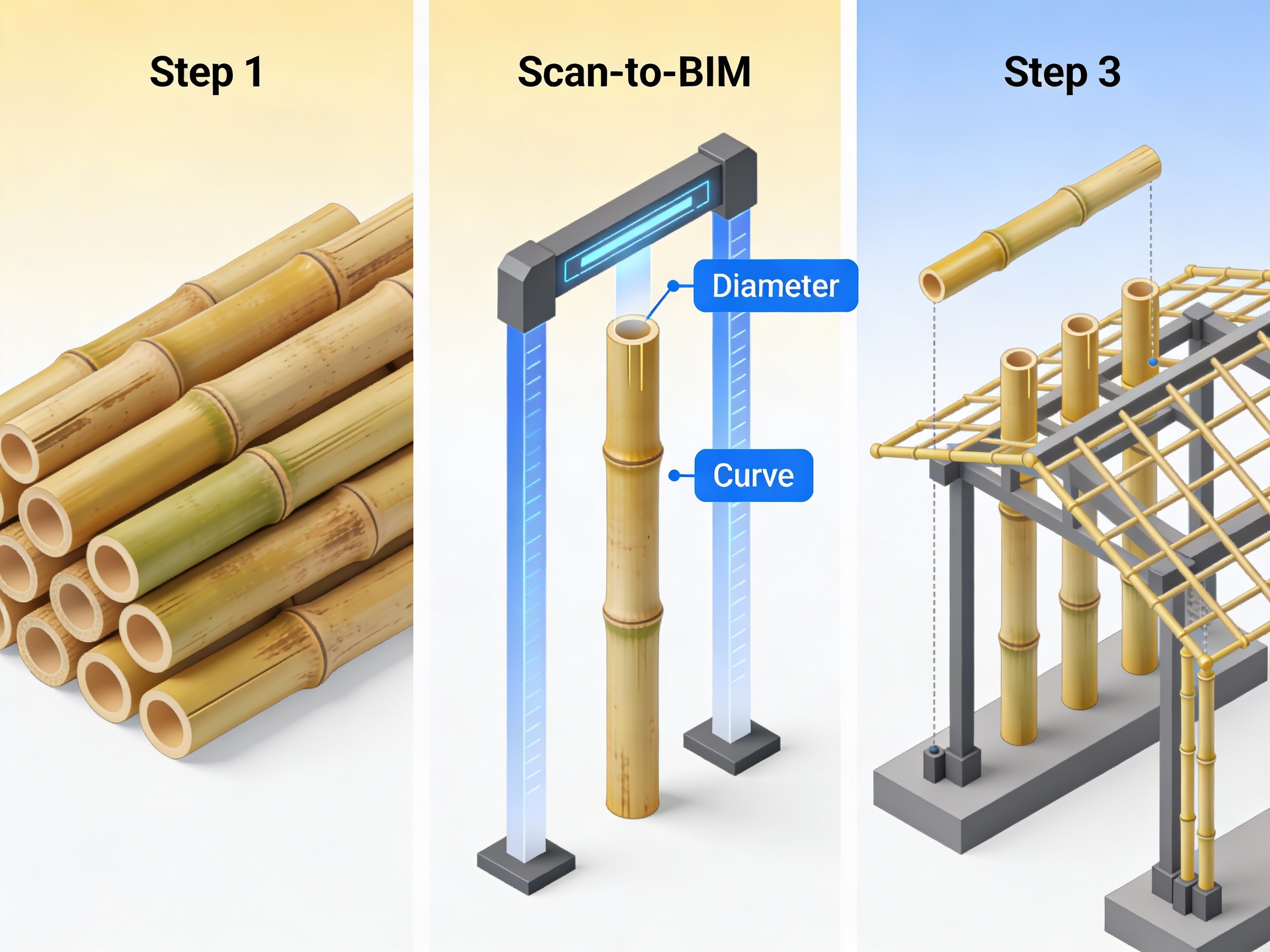
From Passive to Proactive: How Technology is Helping Buildings Give Back to Nature

In architecture, we often talk about making buildings more sustainable. You might have heard terms like ‘passive design’ and ‘regenerative design.’ My last blog post discussed these ideas. Passive design aims to reduce energy and resource use, like a building holding its breath. Regenerative design, however, is about buildings actively giving back to nature, like breathing out clean air and water. How can a building do this? Technology holds the key.

The Limits of Passive Design

Passive design is a very important first step in sustainable architecture. It focuses on using natural elements to make buildings comfortable and efficient. Think about big windows that let in sunlight for warmth in winter, or clever designs that allow cool breezes to flow through a building in summer. These ideas help reduce the need for air conditioning and heating, saving energy and money. For example, the Bullitt Center in Seattle, often called the ‘greenest commercial building in the world,’ uses features like automated windows for natural ventilation and a smart building shell to be energy net-positive [1].

While passive design reduces a building’s negative impact, it doesn’t actively improve the environment. It minimizes harm, but doesn’t create positive change. It’s a crucial foundation, but we need buildings that don’t just take less, but actually give more.

The Rise of Proactive Buildings

This is where proactive, or regenerative, buildings come in. Imagine a building not just as a shelter, but as a living part of its environment. These buildings are designed to act like natural ecosystems. They aim to improve the environment around them, not just reduce their own impact. This means they can generate more energy than they use, clean the air, manage rainwater, and even help local wildlife thrive. It’s about creating a positive impact, making the world a better place just by existing.

One great example is the Omega Center for Sustainable Living in New York. It has a special wastewater treatment system that works like natural wetlands. It cleans water and creates a beautiful space for learning [2]. Another is the Khoo Teck Puat Hospital in Singapore. It has lots of greenery that cools the building and provides a healing space for patients, while also helping local nature [3]. These buildings show how architecture can actively contribute to the health of both people and the planet.

Technology as the Game-Changer

So, how do we make buildings proactive? The answer lies in smart technology. These tools help architects and designers create buildings that work with nature, not against it.

Generative Design and Artificial Intelligence (AI)

Think of generative design as a super-smart assistant for architects. Instead of drawing every line themselves, designers give the computer a set of rules and goals. For example, they might tell it: “Design a building that uses the least amount of material, gets lots of natural light, and stays cool in a tropical climate.” The computer then uses AI to explore thousands, even millions, of design options that a human could never think of. It learns what works best and suggests the most efficient and sustainable designs [4].

This is especially exciting for materials like bamboo. Bamboo is amazing – it grows fast, is strong, and can store carbon. But each bamboo stalk is unique, and its properties can change with moisture and temperature. This allows us to design buildings that truly use bamboo to its full potential, adapting to its natural variations and the tropical climate. AI helps us unlock bamboo’s ‘secret language’ to build stronger, more sustainable structures.

Smart Materials

Imagine a building that can heal itself, change its color to reflect sunlight, or even clean the air around it. This isn’t science fiction; it’s the world of smart materials. These materials can react to their environment and change their properties. For example, some windows can automatically tint themselves to block harsh sunlight, reducing the need for air conditioning. There are even materials that can absorb pollutants from the air or self-repair small cracks, making buildings last longer and require less maintenance [5]. These innovations help buildings become more adaptive and efficient, actively contributing to a healthier environment.

IoT and Sensors

Just like our bodies have senses, smart buildings have sensors. These tiny devices, connected through the Internet of Things (IoT), collect real-time information about everything from temperature and humidity to air quality and how many people are in a room. This data is like a building’s nervous system. It allows the building to understand its own performance and make adjustments automatically. For instance, if a room is empty, the lights can dim, and the air conditioning can reduce its output, saving energy. This constant monitoring and adjustment help buildings operate at peak efficiency, minimizing waste and maximizing comfort [6].

Examples of Proactive Buildings in Action

These technologies are not just ideas; they are being used in real buildings around the world, making a tangible difference:

  1. The California Academy of Sciences (San Francisco, USA): This building combines passive and proactive design. Its living roof provides insulation (passive) while supporting native plants and managing stormwater (proactive). It also generates its own renewable energy and educates on environmental stewardship [7].
  2. The Edge (Amsterdam, Netherlands): Often called the world’s most sustainable office building, The Edge uses a vast network of IoT sensors to monitor everything from temperature and light to CO2 levels and occupancy. This data allows the building to adjust its systems in real-time, optimizing energy use and creating a highly efficient and comfortable environment. It even has a smartphone app that learns user preferences, further personalizing and optimizing the workspace [8]. This is a prime example of how IoT makes a building truly proactive in its energy management.
  3. One Central Park (Sydney, Australia): This residential tower is famous for its vertical gardens, which are not just for show. These gardens act as a living skin, providing natural shading, improving air quality, and reducing the urban heat island effect. The building also incorporates a tri-generation plant for energy and a wastewater treatment system, demonstrating a holistic, proactive approach to urban sustainability [9]. While not explicitly stated as using generative design, the complexity and optimization of such a system often benefit from advanced computational tools.

These examples show that buildings can be more than just shelters; they can be active participants in creating a healthier planet. They demonstrate how technology, from AI-powered design to smart materials and interconnected sensors, is enabling a new era of architecture that goes beyond simply reducing harm to actively giving back to nature.

The Future is a Partnership with Nature, Powered by Technology

The journey from passive to proactive buildings is an exciting one. It represents a fundamental shift in how we think about our built environment. No longer are buildings just static structures; they are becoming dynamic, intelligent entities that can adapt, learn, and contribute positively to the world around them.

This shift is driven by the incredible advancements in technology. Generative design, AI, smart materials, and IoT sensors are not just tools; they are enablers that allow us to design and construct buildings that are deeply integrated with natural systems. They help us understand complex environmental data, optimize material use, and create structures that are resilient and responsive to changing conditions.

Ultimately, the goal is to create a future where every building is a partner with nature. A future where our cities are not just concrete jungles, but thriving ecosystems where human life and natural life coexist and flourish. This vision is becoming a reality, one smart, proactive building at a time. It’s a hopeful vision for architecture, where innovation and sustainability go hand in hand to build a better world for everyone.

References

[1] Aulia Muflih Nasution. (2025, June 26). Passive vs Regenerative Design in Architecture: Practical Insights for Sustainable Building. Retrieved from https://auliamuflih.blog.uma.ac.id/2025/06/26/passive-vs-regenerative-design-in-architecture-practical-insights-for-sustainable-building/

[2] Omega Institute. (n.d.). Omega Center for Sustainable Living. Retrieved from https://www.eomega.org/omega-center-for-sustainable-living

[3] Khoo Teck Puat Hospital. (n.d.). Our Green Hospital. Retrieved from https://www.ktph.com.sg/about-us/our-green-hospital/

[4] Maket.ai. (n.d.). The Role of AI in Sustainable Architecture: How Generative Design is Helping to Reduce Carbon Footprints. Retrieved from https://www.maket.ai/post/the-role-of-ai-in-sustainable-architecture-how-generative-design-is-helping-to-reduce-carbon-footprints

[5] ArchDaily. (2022, May 31). What Are the Smart Materials in Architecture?. Retrieved from https://www.archdaily.com/982583/what-are-the-smart-materials-in-architecture

[6] Neuroject. (2024, September 5). IoT Sensors in Smart Buildings: Enhancing Efficiency. Retrieved from https://neuroject.com/iot-sensors-in-smart-buildings/

[7] California Academy of Sciences. (n.d.). Architecture. Retrieved from https://www.calacademy.org/academy/architecture

[8] PLP Architecture. (n.d.). The Edge. Retrieved from https://plparchitecture.com/work/the-edge/

[9] One Central Park. (n.d.). About. Retrieved from https://www.onecentralpark.com.au/about/

Roots of Resilience: Bamboo Architecture for a Sustainable World

Bamboo architecture is an exciting and innovative approach to building that is gaining recognition around the world. As we face significant challenges such as climate change, urbanization, and the depletion of natural resources, the need for sustainable building materials has never been more critical. Bamboo, a fast-growing grass, offers a unique solution to these challenges. It is not only strong and flexible but also lightweight, making it an ideal material for construction. Understanding the basics of bamboo architecture is essential for appreciating its potential in creating sustainable living spaces.

Bamboo Forest - Generate with AI

Bamboo Forest – Generate with AI

Bamboo has been used for centuries in various cultures, particularly in Asia and South America. Its rapid growth rate allows it to be harvested in just a few years, unlike traditional timber, which can take decades to mature. This characteristic makes bamboo a renewable resource that can help reduce deforestation and promote sustainable forestry practices. As the global population continues to rise, the demand for housing and infrastructure increases, putting pressure on our planet’s resources. Bamboo can help meet this demand while minimizing environmental impact.

One of the most significant advantages of bamboo is its strength-to-weight ratio. Bamboo is incredibly strong, often compared to steel in terms of tensile strength. This means that structures made from bamboo can be both lightweight and durable, allowing for innovative architectural designs that are not only functional but also aesthetically pleasing. The flexibility of bamboo also makes it resistant to earthquakes and other natural disasters, providing safety and security for those who live in bamboo structures.

In addition to its physical properties, bamboo is also an environmentally friendly material. It absorbs carbon dioxide from the atmosphere, helping to mitigate climate change. By using bamboo in construction, we can reduce our carbon footprint and contribute to a healthier planet. Furthermore, bamboo can be grown in a variety of climates and soil types, making it accessible to many communities around the world. This versatility allows for local sourcing of materials, reducing transportation emissions and supporting local economies.

Bamboo architecture aligns closely with several Sustainable Development Goals (SDGs) established by the United Nations. For instance, it contributes to Goal 11, which aims to make cities and human settlements inclusive, safe, resilient, and sustainable. By incorporating bamboo into urban planning and development, we can create affordable housing solutions that are both environmentally friendly and culturally relevant. Additionally, bamboo supports Goal 12, which focuses on ensuring sustainable consumption and production patterns. By promoting the use of renewable resources like bamboo, we can move towards a more sustainable future.

The use of bamboo in architecture also encourages community involvement and traditional craftsmanship. Many communities have a rich history of working with bamboo, and by reviving these practices, we can empower local artisans and preserve cultural heritage. This not only creates job opportunities but also fosters a sense of pride and ownership within communities. As more architects and builders recognize the potential of bamboo, there is an opportunity to create a new wave of sustainable architecture that honors traditional techniques while embracing modern design principles.

Moreover, bamboo architecture can play a crucial role in disaster relief and recovery efforts. In areas affected by natural disasters, bamboo can be quickly sourced and constructed into temporary shelters. Its lightweight nature allows for rapid assembly, providing immediate housing solutions for those in need. This adaptability makes bamboo an invaluable resource in times of crisis, demonstrating its potential to address urgent humanitarian needs.

As we look to the future, the importance of bamboo architecture cannot be overstated. It represents a shift towards more sustainable building practices that prioritize environmental health and social equity. By embracing bamboo as a primary building material, we can create structures that are not only beautiful and functional but also contribute to the well-being of our planet and its inhabitants. The integration of bamboo into modern architecture is not just a trend; it is a necessary step towards a more sustainable and resilient future.

In conclusion, bamboo architecture offers a promising solution to some of the most pressing challenges we face today. Its unique properties, environmental benefits, and alignment with sustainable development goals make it an essential material for the future of construction. As we continue to explore innovative ways to build and live sustainably, bamboo stands out as a beacon of hope, reminding us that nature can provide the solutions we need to create a better world for generations to come. Embracing bamboo in architecture is not just about building structures; it is about building a sustainable future.

Bamboo Parametric Curve Structure

I got this parametric script from Architutors, one of the YouTube accounts that shares parametric modeling. This is the link to the original parametric modeling: https://www.youtube.com/watch?v=HkE99xfG8CQ.

This is the original parametric script that I tried to build using the script I got from the YouTube link.

This is the result of the parametric script.

On the original script the curve cannot be change using parameter, so i put some changed in the script by using 3 point circle.

Furthermore, i put some change in the circle, so we still can change the parameter the diameter and the height using offset curve and move command.

In essence, this is the total of the parametric script that i have been changed and the result of the parametric modeling.

However, i believe that there is still some changed can be make to the basic curve, from the circle to the polyline arc using PolyArc command for the parameter.

The basic curve changed to be flexible curve that can be changed through the parameter. The result from the script is:

The final parametric script consist of all changed that I have been made is: