
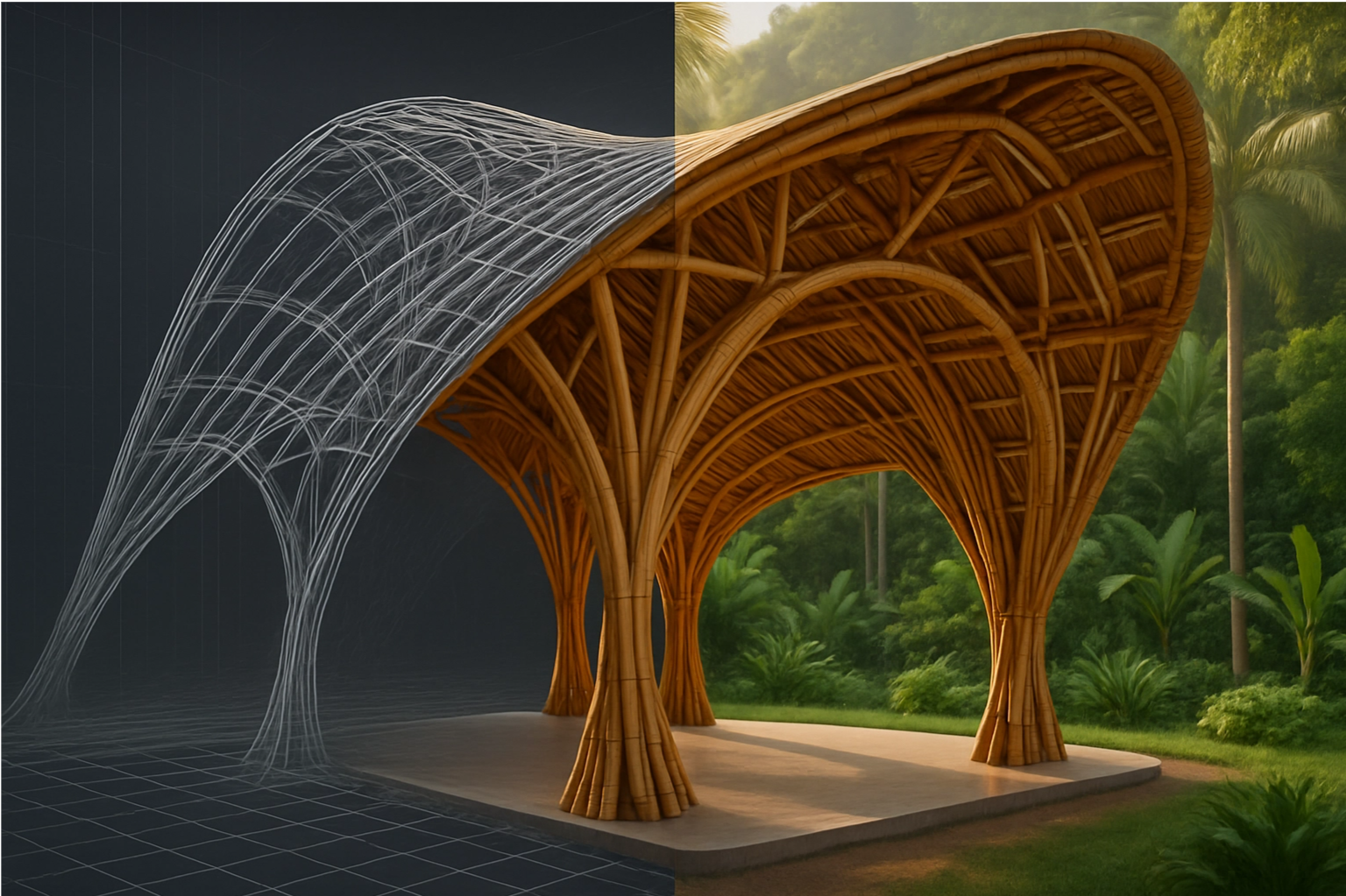
building structure transitioning from a digital parametric wireframe into a real-world bamboo pavilion
Consistency is often more difficult than intensity. It is easy to sprint; it is hard to walk every day for a year.
Today marks a small but meaningful milestone for me: I have successfully published a blog post every single month for the past 12 months. One year of consistent writing.
To some, this might seem trivial. It’s just a blog, right? But for me, this represents a discipline I’ve been trying to cultivate. In a world of instant updates and fleeting social media stories, the act of sitting down to write a thoughtful, long-form piece once a month feels like an act of resistance. It’s a commitment to deep thinking over quick scrolling.
When I started this commitment a year ago, I had a few hopes.
For Myself: Writing forces clarity. You think you understand a concept—like computational design or sustainable bamboo construction—until you try to explain it to someone else. Writing these posts has been my best method of study. It forces me to research deeper, structure my thoughts, and articulate my arguments.
For My Students: I wanted to create a resource that extends beyond the classroom. A lecture lasts 100 minutes, but a blog post lasts forever. Students can revisit these ideas about parametric design, environmental responsibility, or professional ethics whenever they need them.
For the Institution: I hope this blog contributes, in a small way, to the scientific culture of Universitas Medan Area. Academic discourse shouldn’t just happen in closed journals; it should be accessible, public, and engaging.
For the Public: Architecture can feel elitist or inaccessible. I try to write in a way that bridges the gap – making complex ideas about resilient cities or design technology understandable to anyone who cares about the built environment.
Looking back at the archive, I see a map of my own intellectual journey this year.
We explored computational design – demystifying Grasshopper not just as a tool for making weird shapes, but as a way to think algorithmically.
We dived into bamboo architecture, discussing how traditional materials can be optimized with modern technology.
We tackled climate resilience, especially after the floods of November. The post “Designing for Cyclones” wasn’t just an article; it was a response to a real crisis we all faced.
We reflected on education, asking hard questions about why hydrology isn’t foundational in design schools.
Each post was a snapshot of what I was learning, questioning, or fighting for at that moment.
I don’t know who reads every post. Analytics give numbers, but they don’t tell stories.
But then, something surprising happened in October.
Someone approached me on campus – someone I didn’t know – specifically to discuss bamboo. They weren’t a student in my class, but they had read my blog post about bamboo construction joints. They came with specific questions, ready to discuss preservation techniques and structural details.
I was genuinely surprised.
To be honest, sometimes writing a blog feels like shouting into the void. You press “publish” and wonder if anyone actually cares. But that conversation in October proved that words travel. It proved that there are people out there – students, practitioners, enthusiasts – who are hungry for this kind of specific, technical knowledge.
That moment was a turning point for me. It shifted my perspective from “I have to write this for my schedule” to “I get to write this for a community.”
It is the best kind of reward. Not the traffic numbers, but the real, human connection that starts with a shared idea.
I hope this blog serves as a small spark.
A spark for students to read more than just captions.
A spark for colleagues to share their own expertise publicly.
A spark for anyone to start writing their own thoughts.
Because knowledge that isn’t shared is knowledge that stagnates. Writing keeps it moving.
So, here is to consistency.
To showing up at the keyboard even when I’m tired.
To researching topics that challenge me.
To pressing “Publish” even when I’m not sure if it’s perfect.
Thank you to everyone who has read, shared, or discussed these posts over the last year. You are the reason I keep writing.
Let’s see what the next 12 months will teach us.
Keep reading. Keep writing. Keep learning.