Medan, December 12, 2025
Two Weeks After
I’m sitting at my desk, still in the clothes I wore to the seminar this morning. It’s evening now, and the adrenaline is fading. My voice is hoarse from speaking.
Two weeks ago, my city flooded. November 26-27, 2025. Cyclone Senyar. 85,000 people evacuated in one night. 514 identified flood points in Medan. 1,502 flood events recorded across Indonesia this year. 743+ deaths from Sumatra floods.
Today, I stood in front of a room full of educators and presented research about why this happened. About design failures. About system collapse. About professional responsibility.
This should feel disconnected – talking about theory while the city is still recovering. But it’s the opposite. Crisis is exactly when these conversations matter most.
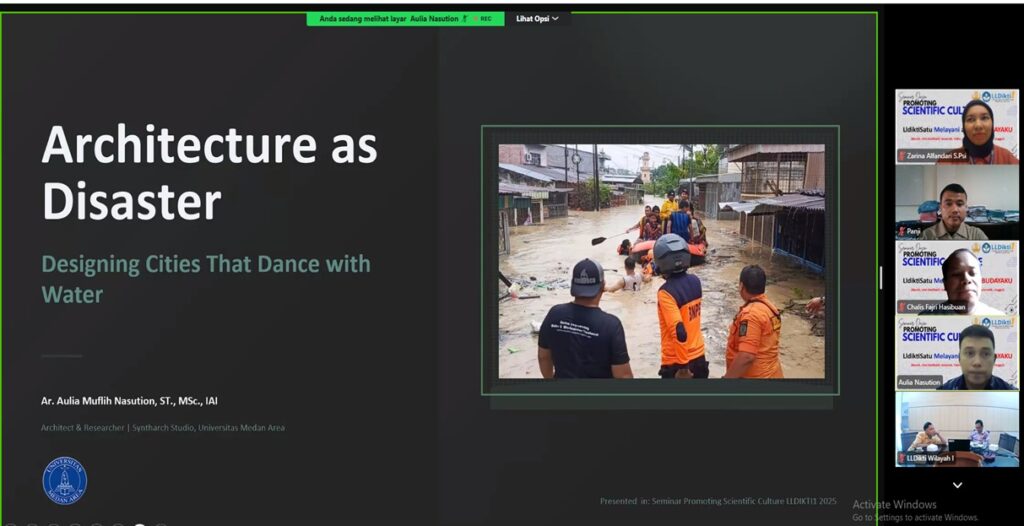
Webinar Presentation in December 12, 2025
Why This Seminar Happened—Promoting Scientific Culture
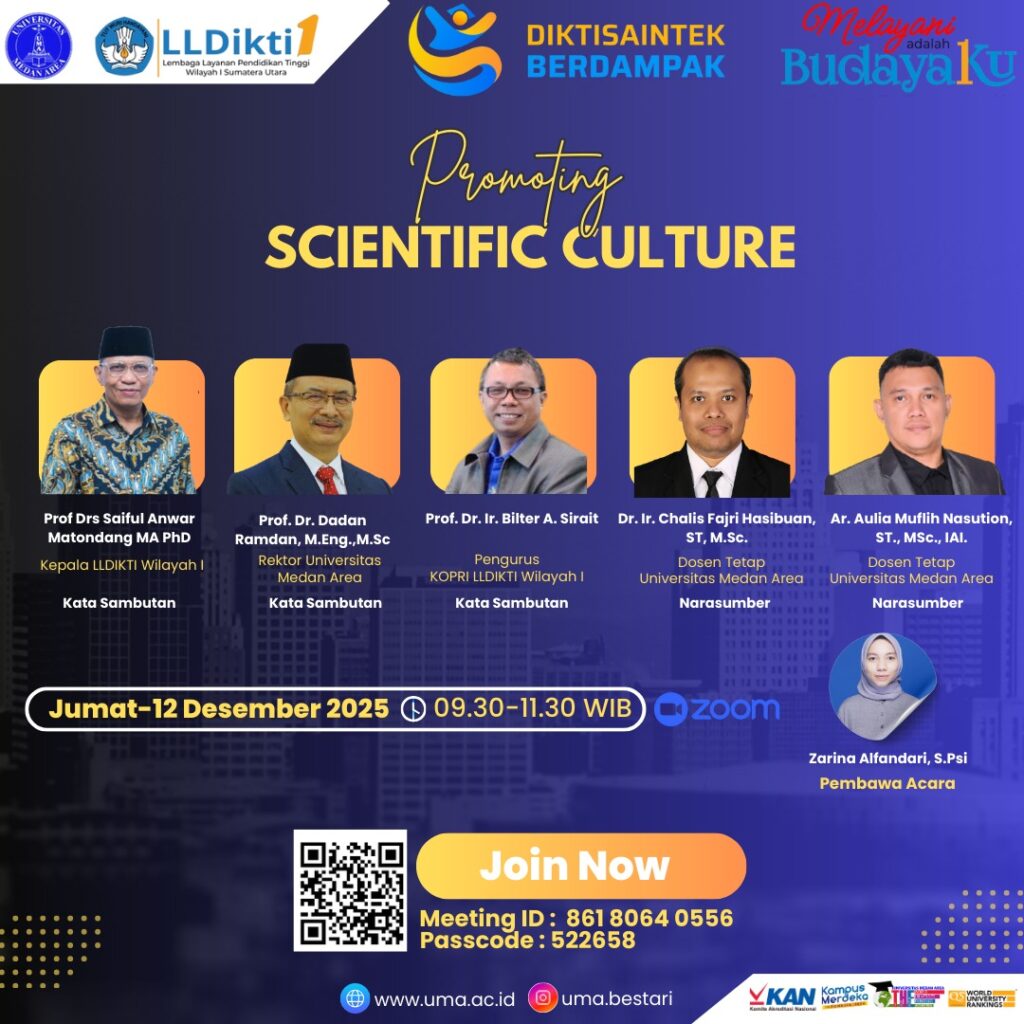
E-flyer of Promoting Scientific Culture Webinar from LLDIKTI 1
LLDIKTI1 (the regional higher education authority for North Sumatra and Aceh) organized a seminar series called “Promoting Scientific Culture.” The basic question it asks is simple but fundamental: how do we make knowledge matter?
Not just produce knowledge. But ensure that research actually influences decisions. That academia connects to reality. That when universities study problems, that knowledge reaches people who can solve them.
This is urgent in our region. We face climate vulnerability, flooding, rapid urbanization, limited resources. We have universities with brilliant researchers. We have data, solutions, expertise. But the gap between what we know and what we do remains enormous.
LLDIKTI1 created this seminar series to try to close that gap. To bring educators from different disciplines and institutions together. To facilitate dialogue. To ask: how do we build a culture where knowledge is taken seriously?
That’s why this seminar mattered. Not just another presentation. But an intentional effort to strengthen how academia functions in this region.
Meeting Backround Promoting Scientific Culture Webinar
Universitas Medan Area As Host
Universitas Medan Area (UMA) was selected as the primary coordinator for this week’s seminar. That selection meant something.
LLDIKTI1 chose UMA. Which signals institutional recognition. That the university has something to contribute. That we’ve been building research infrastructure, encouraging faculty publication, creating systems that support scholarly work.
But more importantly, it’s a responsibility. Hosting a seminar isn’t trivial. It requires allocating resources, coordinating logistics, ensuring quality execution. UMA chose to invest in this. Which sends a message to faculty and students: knowledge that matters is important here. Research that connects to reality is valued here.
When I learned UMA was hosting, my first reaction was pride. Pride that my institution is being recognized at this level. My second reaction was responsibility: we must ensure this is well-executed. That it matters.
That context grounded me as I prepared my presentation. This wasn’t just my work. It was UMA’s commitment being tested. The institution’s values being put on display.
The Presentation I Gave
I began with condolences. Not as academic preamble. But as genuine acknowledgment. People in that room come from places hit by floods, landslides, disasters in recent weeks. Some lost family. Some lost homes. And I was about to talk about design theory.
I started with numbers: 85,000 evacuated. 514 flood points. 1,502 events this year. 743+ deaths.
Then I said the thing that can’t be unsaid: “This is not a weather event. This is a system failure.”
Because it’s true. If this were just weather, there’s nothing to blame ourselves for. But if it’s a system failure, then we – planners, architects, engineers, policymakers – we have responsibility.
I presented four reasons Medan floods so catastrophically:
- Impermeable surfaces. Concrete and asphalt prevent natural infiltration. Every square meter covered in hard surface is a square meter that no longer absorbs water.
- Rapid urbanization. Growth without hydrological planning. We expand cities faster than we update water management systems.
- Centralized systems. All drainage feeds into a few main channels. When those channels fail, everything fails at once.
- Climate change. Intensifying consequences of all the above.
These are choices. Every concrete surface is a choice. Every drainage system is a choice.
Then I showed the shift: from Resistance (fighting water) to Resilience (tolerating, adapting, recovering). Like trees – rigid ones break in the wind, flexible ones dance with it.
I presented solutions at three scales:
- City Scale: Policy and planning. Semarang’s 40% complete flood control project integrating green infrastructure.
- Neighborhood Scale: Green infrastructure. Rain gardens and bioswales designed with 2-3x normal capacity for extreme events. Permeable paving. Water squares. Tebet Eco Park in Jakarta is a real example.
- Building Scale: Elevation—raising main floors above flood lines. Amphibious design. Water-resistant materials. Each building becomes a resilience unit.
Real proof: Brisbane – 91% resilience in retrofitted homes, 70% insurance premium drop. Rotterdam – Water Squares that are beautiful public spaces and stormwater management. Semarang – doing this now in our region.
The One Question That Changed Everything
After I finished, there was one question.
Just one.
Someone asked: “Should our design standards be based on data about rainfall? How do we calibrate our designs to handle extreme events?”
This was the exact question that mattered. Not about theory. But about practical standards. Implementation. How do we actually build this?
And that question opened something crucial.
I answered by connecting it directly to Cyclone Senyar. November 26-27. What just happened to our city.
The real question is: do our design standards assume cyclones like Senyar won’t happen again? Or do we design assuming they will?
They will happen again. Maybe not next year. But again. And if we haven’t changed, we’ll face the same disaster.
Elevation becomes critical. Buildings with elevated main floors – not as luxury, but as standard – would have fared differently. Critical systems wouldn’t have been submerged. Displacement would have been reduced.
For green infrastructure, capacity must be designed for 2-3 times normal conditions during extreme events. A bioswale holding 100mm won’t help when 300mm falls. Design it for 200-300mm. Yes, it’s overkill in normal years. But in cyclone years, it’s the difference between managing a crisis and experiencing a disaster.
This is design becoming precautionary. Not reactive. Not “what if.” But “when.”
That one question opened something. We must design knowing that extreme events will happen again. And we must design so that when they do, impact is manageable, not catastrophic.
The conversation could have continued. More people could have asked. Dialogue could have deepened. But it ended there. One question. Answered. But not built upon.
And I felt something: disappointment mixed with recognition that quality matters more than quantity. One person thinking critically about design standards is worth more than a room passively receiving information.
Going Forward – For My Students And My Community
As I reflect on today, I’m clear about what must happen next.
For my students:
When I return to teaching, every studio project will start with hydrological analysis. Not as optional content. Not as afterthought. As foundation.
Every design will begin: “Where does water go? How do we design for that?”
Because my students will make decisions that affect real people. Some will design buildings. Some will work for developers. Some will enter government planning. Every choice they make – where to place systems, what materials to use, whether to think about water – will have consequences.
I need them to understand that designing is a form of power. The power to create resilience or vulnerability. The power to help people survive cyclones or to increase their suffering.
For my community:
I need to stop pretending that research alone is enough. Knowledge existing in university papers and presentations while the city outside keeps flooding – that’s not acceptable.
I need to find more ways to make my work matter practically. To connect with planners and developers. To ensure that what I learn is actually used in decision-making. To push for policy change based on evidence.
Concrete standards that must change:
Design standards must assume extreme events will recur. Not “might happen.” But will. Cyclones like Senyar. Rainfall like November 26-27. We design for those, not average conditions.
Infrastructure capacity must exceed by 2-3x in extreme weather zones. Not just prudent. It’s what works, based on what we just experienced.
Elevation is not luxury. It’s necessity in flood-prone, cyclone-vulnerable areas. Standard practice, not exception.
The culture question:
I also can’t ignore what happened in that room. Limited engagement. One question. Limited discussion.
From a room full of educators – people who shape how students think – the engagement was limited. And that concerns me deeply.
If educators don’t model critical thinking, don’t demonstrate good questioning, what culture of inquiry are we building? How do we expect our students to ask hard questions if we don’t?
This is exactly what “promoting scientific culture” should address. But it didn’t happen. And that’s a problem we need to name and address.
The Commitment
Two weeks after Cyclone Senyar devastated Medan, I stood in a room and presented research about why cities flood. I talked about design failures and professional responsibility. I answered one good question from someone thinking practically about implementation.
I didn’t inspire a room full of engaged scholars. But I did something else: I modeled what responsibility looks like. To speak about hard things. To connect research to reality. To answer practical questions with concrete strategies.
Now I need to carry that forward. In how I teach. In how I engage with my community. In how I push for change.
The gap between knowing and doing is immense. But it’s filled by choices. People deciding to speak or stay silent. Educators deciding to model critical thinking or accept passive participation. Professionals deciding to advocate for change or accept status quo.
I choose to speak. I choose to make my work matter. I choose to help my students and my community understand that design choices have real consequences.
That’s my work now. Not just presenting. But helping to shift the culture of how we engage with knowledge, with responsibility, with the future we’re designing.
 Loading...
Loading...



 Reload document
  Open in new tab